
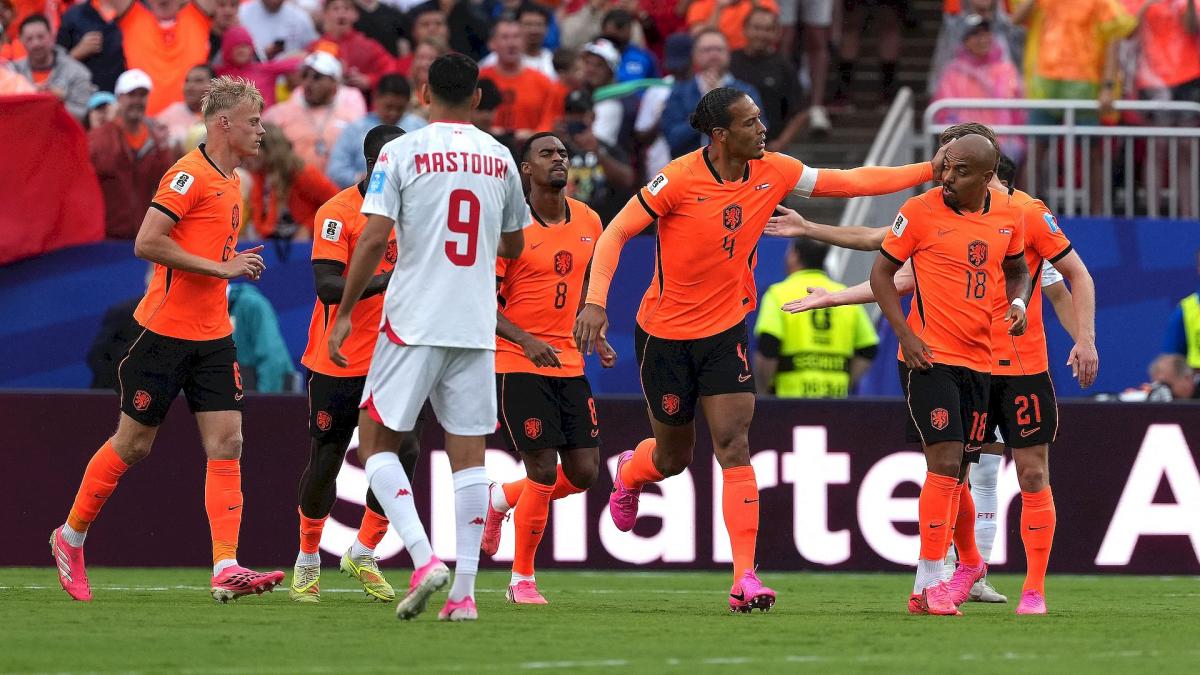
The numbers illustrate the magnitude of the disaster. Tunisia has the worst goal difference of the tournament (-10), behind Qatar, Curaçao, and Uzbekistan. It becomes the first African team to concede five goals in an opening match, and only the second nation from the continent, after Zaire in 1974, to let in at least nine goals in two World Cup games. Beyond the tournament, it’s a fifth consecutive defeat in all competitions, something unseen since 1987.
A crisis that went far beyond the pitch
This debacle wasn’t built in three matches. It started even before kickoff, with a Tunisian Federation deep in instability, and became official right after the heavy opening defeat against Sweden, which cost Sabri Lamouchi his job in the middle of the competition. A radical decision, made in panic, which spoke volumes about the crisis atmosphere surrounding the national team.
It was within this explosive context that Hervé Renard was urgently called back for a commando mission that everyone knew was almost impossible to accomplish in so little time. Unsurprisingly, the miracle did not happen: 4-0 against Japan for his debut, a coach admitting he was "ashamed" of his team’s performance, then a final match against the Netherlands where his appeal to "pride and dignity" went unanswered.
Renard caught in a trap
On a personal note, the North American adventure did nothing to improve Hervé Renard’s World Cup record either. The Frenchman now has a 75% defeat rate on the bench in final phases (six losses in eight matches), a ratio exceeded in World Cup history only by Colombian Hernán Darío Gómez. His team also conceded the fastest goal in Tunisian World Cup history against Japan, before that record was broken again against the Netherlands, in just the third minute.
Nonetheless, the episode also revealed a Renard who was clear-sighted and made no excuses, taking responsibility for the results without looking for outside scapegoats. He also left some ambiguity about his future, mentioning a special attachment to the African continent and a desire to continue his career there, without, however, committing firmly to an extension with Tunisia. His contract, drawn up in emergency, only covered the duration of the World Cup: now the ball is in the Tunisian Federation’s court, who must decide whether they want to turn this firefighting mission into a long-term project.
What’s next on the calendar?
The schedule waits for no one. Tunisia will enter the 2027 AFCON qualifiers as early as September 2026, which will be held in Kenya, Uganda, and Tanzania. Placed in Pot 1 as a seeded team, the Eagles of Carthage will have to go through a group stage spread over three international windows:
Matchdays 1 and 2: September 21 to October 6, 2026
Matchdays 3 and 4: November 9 to 17, 2026
Matchdays 5 and 6: March 22 to 30, 2027
A campaign that will come quickly, almost too quickly, for a team still in shock and a federation that will have to make a quick decision on its technical staff. Continuity with Renard if a project takes shape, or a new rebuilding phase with a different profile: the choice made in the coming weeks will weigh heavily on Tunisia’s ability to regain, as soon as this autumn, the credibility largely lost in the summer of 2026.
Turning the page
Beyond the damning statistics, World Cup 2026 has above all laid bare the structural weaknesses of Tunisian football: shaky management, a weakened locker room, and a team unable to respond on the pitch to adversity. The chapter of this World Cup is closed, but the real test for Tunisia begins now—in the ability of its leaders to turn this humiliation into a wake-up call, rather than just a quickly forgotten parentheses.
Join our sports community!
Follow us on social media to never miss real-time sports news.
À propos de l'auteur

Oumar WANE
Rédacteur sportif
Passionné de sport depuis toujours, partage avec vous les dernières actualités et analyses du monde sportif.