
Burkina Faso: The causes of chronic instability on the bench of Stallions
For nearly three decades, the position of coach of the Burkina Faso Stallions has resembled an ejection seat. In 28 years, since about 1998, 16 coaches have succeeded each other at the head of the national team, for an average duration of 18 months and 22 days per coach. An incessant turnover which illustrates in itself the structural difficulties, the high demands and sometimes the excessive impatience that characterize the technical management of the Stallions.
Philemon MBALE · Author profile ·
Listen to this story
Audio version in preparation · read aloud by your browser meanwhile
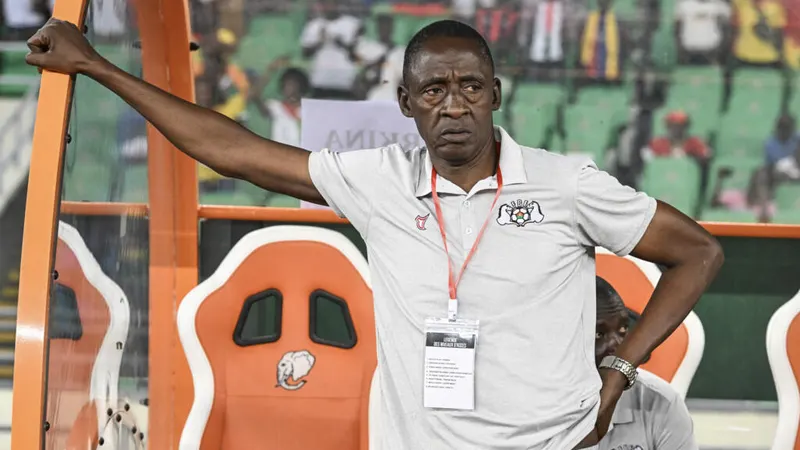
Burkina Faso has experienced moments of glory: final of the AFCON 2013, semi-finals in 2017 and 2021, solid performances in the group stage in recent years. Yet, stability is sorely lacking. Coaches, even the most successful ones, struggle to settle down sustainably. There are many reasons: the results fluctuate, intense popular pressure, frequent changes at the head of the Burkina Faso Football Federation (FBF), and the country’s unstable socio-political context. Everything contributes to transforming the bench of Stallions into a very high-risk position.
Since the late 1990s, the Burkinabe bench has seen an impressive gallery of profiles. Locals like Sidiki Diarra, Idrissa Malo Traoré, Kamou Malo or even Brama Traoré. Expatriates like Paulo Duarte, Paul Put, Didier Notheaux, René Taelman, Oscar Fulloné, Hubert Velud... Everyone arrives with promises. Those to stabilize the game, qualify for a World Cup, aim for the continental podium but often relaunch after an early elimination, a series of draws or a simple AFCON deemed disappointing.
Among this waltz of coaches, some names stand out for their ability to last:
Paulo Duarte (twice): the Portuguese technician holds the absolute record. First passage from March 2008 to February 2012 about 47 months, then return from December 2015 to June 2019 about 42 months. In total, nearly 7 and a half years cumulated on the Burkinabe bench. He obtained a third place in 2017 and laid the foundations for a golden generation.
Paul Put: the Belgian lasted 34 months and 18 days from 2012 to 2015. He led the Stallions to their first AFCON final in 2013.
Kamou Malo: the former Burkinabe international lasted 30 months and 13 days from 2019 to 2022. He maintained the level by qualifying the country for the semi-finals of the AFCON 2021.
With the departure of Brama Traoré, the future coach will become the 17th in 28 years. A figure that speaks for itself. In February 2026, the FBF received 82 CVs for the vacant position. A figure that speaks volumes. The position is still attracting, but no one seems to be able to settle there permanently. This time, it will be necessary for the Federation to choose patience rather than waltz.
Why such instability?
The Burkina Faso Football Federation (FBF) often demands immediate results such as qualification for the AFCON finals, progression in the FIFA ranking, performance in the African Cup. But the pool of Burkinabe talents, although rich (Bertrand Traoré, Edmond Tapsoba, Dango Ouattara, Issa Kaboré etc.), sometimes suffers from a lack of tactical continuity.
Add to that the extra-sporting constraints such as political instability, logistical difficulties, pressure from supporters and authorities, and the cocktail becomes explosive. Even experienced foreign coaches, like Paulo Duarte or Paul Put, ended up leaving, worn out or in disagreement.
Requirement for immediate results
Burkina Faso lives on the myth of 1998 at home, 4th place , and 2013, final lost to Nigeria. Any underperformance is experienced as a major failure, even when the opponent is more financially and structurally armed.
Institutional weakness of the Federation
The FBF does not always offer a stable framework to the coach. The objectives set are often unrealistic compared to the means: infrastructure, detection, preparation.
Security and economic context
The country has been experiencing a major security crisis since 2015. Many talents expatriate early, the concentration of internships is complicated, home matches sometimes relocated for stadium not in compliance with international standards. Difficult to build in the long term under these conditions.
Unfavourable regional comparison
Opposite, Senegal with Aliou Cissé since 2015 then Pape Thiaw, Morocco with Walid Regragui extended, Ivory Coast with Emerse Faé, bet on stability. Burkina pays cash for his lack of patience.
What future to break the curse?
The question today is simple: will the next coach be able to reverse the trend? The FBF promised a rigorous selection process to find Brama Traoré’s replacement. But without a real reform based on increased confidence in the long term, a clear development plan, the 17th risks experiencing the same fate as its predecessors.
To reverse the trend, several avenues:
Appoint a selector for a minimum cycle of 4 years, with stability clause except major disaster.
Strengthen the local technical staff around an experienced head coach. Example: local duo plus foreign advisor.
Investing in continuity: better accompany the U20/U23 towards the A, as do the Ghanaian or Malian neighbors.
Realistic objectives: systematically aim for the AFCON quarter- or semi-finals, rather than the title every two years.
As long as the bench remains the most precarious position in Burkinabe football, the Stallions risk remaining this moving paradox: a talented team, collective, loved, but doomed to start from scratch after each edition of the AFCON. Burkina Faso has the potential to become a regular force in African football again. Still, it needs time and stability. On the bench of the Stallions, this is perhaps the greatest challenge of all.