
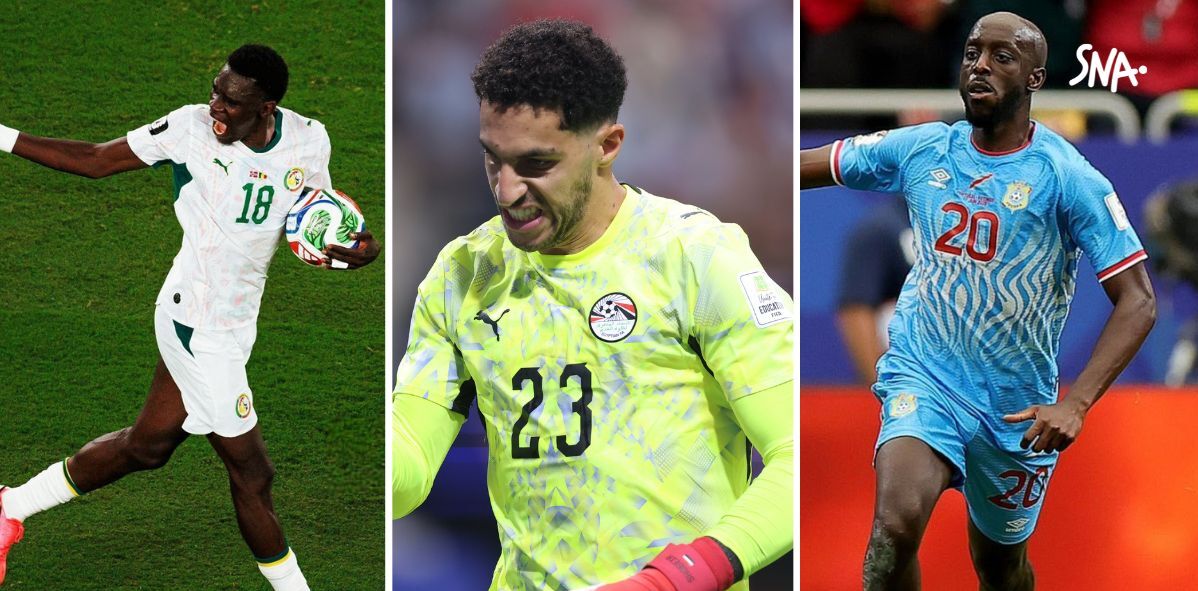
10. Vozinha (Cape Verde)
At 40 years old, Vozinha was one of the main architects of Cape Verde's first ever participation in a World Cup. The Cape Verdean goalkeeper notably made seven saves during the draw against Spain (0-0) on June 15, then eight against Argentina during the elimination after extra time in the round of 32 (2-3) on July 3.
His performances also sparked a phenomenon on social media: starting with around 50,000 followers on Instagram before the tournament, he had nearly 25 million after the match against Argentina. Beyond the numbers, Vozinha will remain one of the unexpected faces of this World Cup.
9. Mostafa Shobeir (Egypt)
At 26, the Al Ahly goalkeeper established himself as one of Egypt's revelations. Decisive straight away in the draw against Belgium (1-1), Mostafa Shobeir then saved a penalty from Mehdi Taremi against Iran (1-1), a result that qualified the Pharaohs for the knockout phase.
Egypt then eliminated Australia in a penalty shootout after a 1-1 draw (4-2 on penalties). In the round of 16 on July 7, Shobeir stopped a penalty from Lionel Messi while the Pharaohs were leading 2-0. Argentina eventually turned the match around to win 3-2, but this did not erase the Egyptian keeper's performance.
8. Yassine Bounou (Morocco)
Yassine Bounou confirmed his status as a reference in Morocco's goal. After the draw against Brazil (1-1) and the clean sheet victory against Scotland (1-0), the Al-Hilal goalkeeper once again played a key role in the knockout matches.
Against the Netherlands in the round of 32 (1-1, 3-2 on penalties), he stopped the decisive attempt from Crysencio Summerville; two other Dutch players missed the target. Bounou then contributed to the win against Canada in the round of 16 (3-0). Despite the elimination by France in the quarterfinals (0-2), he still saved a penalty from Kylian Mbappé and made several important interventions.
7. Ayyoub Bouaddi (Morocco)
Called up for the first time by Morocco's senior team for the World Cup, Ayyoub Bouaddi was 18 years and 252 days old at the start of the competition. The LOSC midfielder was thus among the youngest players in the tournament.
With his composure, quality of control and game reading, Bouaddi quickly established himself at the heart of Mohamed Ouahbi's system. His maturity impressed observers starting with the draw against Brazil, and it was confirmed throughout Morocco's run to the quarterfinals.
6. Nicolas Pépé (Ivory Coast)
Used in a more central role by Emerse Faé, Nicolas Pépé brought his technique and experience to Ivory Coast. The Villarreal striker notably scored a brace against Curaçao, in the 7th and 64th minutes, to give the Elephants a 2-0 victory and their first qualification for the World Cup knockout stage.
Pépé finished the tournament with two goals and one assist. His partnership with the young Ivorian strikers was one of the strengths of the Elephants’ campaign.
5. Amad Diallo (Ivory Coast)
As was the case at CAN 2025, Amad Diallo once again changed the course of Ivorian matches. Coming off the bench against Ecuador, the Manchester United winger scored the winning goal (1-0).
In the round of 32, Amad again scored as a substitute to equalize against Norway. Ivory Coast eventually lost 2-1, but his energy, dribbling, and ability to create danger confirmed his role as an attacking spark.
4. Brahim Díaz (Morocco)
After the painful episode of his missed penalty in the CAN 2025 final, Brahim Díaz regained a major influence in Morocco’s play. Less exposed in finishing, the Real Madrid player stood out for his creativity and final pass.
With four assists, he finished as the top African assister of the World Cup. He ranked second overall, tied with Bruno Guimarães, behind Michael Olise and his five assists, according to FIFA statistics as of July 9.
3. Ismaël Saibari (Morocco)
Officially signed by Bayern Munich on July 1st, Ismaël Saibari scored in all three of Morocco’s group stage matches: against Brazil (1-1), Scotland (1-0), and Haiti (4-2). With three goals, he finished as Morocco’s top scorer of the tournament.
Saibari did not score from open play in the knockout phase, but he converted the decisive penalty against the Netherlands. Suffering a muscle injury, he was substituted after 22 minutes against Canada and then missed the quarterfinal against France.
2. Yoane Wissa (DR Congo)
The Newcastle striker led the attack for DR Congo on their World Cup return. His goal against Portugal (1-1) on June 17 gave the Leopards their first-ever goal and point in the history of the competition, including Zaire’s appearance in 1974.
Wissa then scored a brace against Uzbekistan in the 3-1 win that sent DR Congo into the round of 32. With three goals, he was the main architect of the first Congolese victory at a World Cup and the Leopards’ historic qualification for the knockout phase.
1. Ismaïla Sarr (Senegal)
After a missed opportunity against France on the first match day (1-3 loss), Ismaïla Sarr found his form again. The Crystal Palace striker scored a brace against Norway despite Senegal's defeat (2-3), then netted a goal in the 5-0 win over Iraq.
Sarr scored again in the round of 32 against Belgium, who ultimately won 3-2 after extra time. With four goals and one assist, he finished as Africa's top contributor at the 2026 World Cup in terms of goals and assists. This record justifies his first-place ranking in the SNA standings.
Join our sports community!
Follow us on social media to never miss real-time sports news.
Tags
À propos de l'auteur

Aimé ATTI
Rédacteur sportif
Journaliste, commentateur sportif, baignant dans le sport et le football africain.