
Ajara Njoya, Indomitable Lioness and committed campaigner
Cameroon's Ajara Njoya is a footballer heavily involved in charity work. She talks about the work of her foundation.
Sport News Africa · Author profile ·
Listen to this story
Audio version in preparation · read aloud by your browser meanwhile
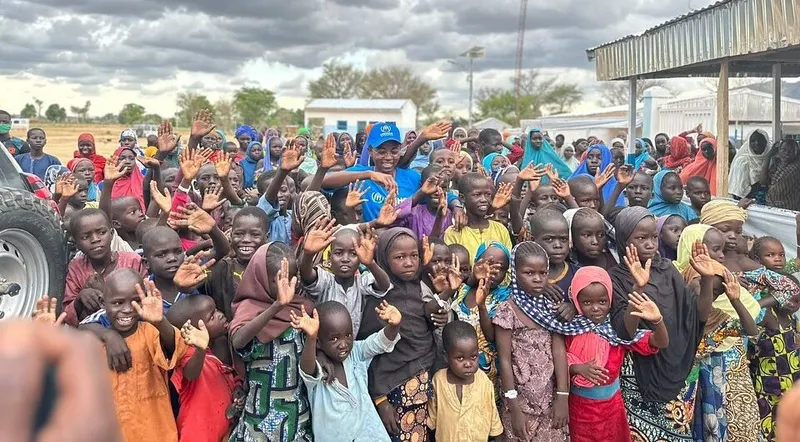
You are an African sportswoman who is very involved in charity work. For example, you visited a refugee camp in the north of Cameroon. Where did your desire to get involved in this kind of work come from?
Ajara Njoya: Even before the UNHCR asked me to get involved (United Nations High Commissioner for Refugees, editor's note), I was personally committed, through my association, to supporting people in need. I come from a poor family, and for me, reaching out to people who need help is vitally important. If I'm going to give, I prefer to do it with people who are genuinely in need, like when I went to a refugee camp in the north with the UNHCR. They asked me to join them as part of Refugee Week. We ran a series of campaigns that showed me the precarious conditions people were facing. Seeing people displaced from one country to another, living in difficult conditions, is not easy. I was deeply affected by the situation and I even plan to go back, this time at my own expense, to help them.
Read more on the subject: Tabita Chawinga and Njoya Ajara sensational with Inter Milan
You have your own association and help young girls in particular, but not only them. What kind of work do you do?
Ajara Njoya: With my team, we have covered the school fees of ten pupils, five English-speaking and five French-speaking. I have been looking after their schooling for three years now and it is going well. Girls' education is an important cause for me. Through my association, we also make donations to prisons and hospitals to help the most disadvantaged.
Incidentally, to highlight all your work, you post a great deal on social media. How do you use it to drive positive action?
Ajara Njoya: I use Facebook and Instagram to share inspiring stories, experiences and key moments from my involvement in social initiatives. By showing the impact of these initiatives, I aim to raise awareness and inspire others to join the cause. For me, it is essential to communicate positively on social media. We all know there can be negativity on there, but at my level I am well supported by a very good team who know when we need to activate my accounts. I only use my pages for the causes I support and my social commitment.
What social initiatives do you plan to carry out next and share on Facebook and Instagram, where you are most active? And how do your campaigns work in practice?
Ajara Njoya: The reach of Meta's platforms helps amplify the visibility of my messages, ensuring that my social work and my support for associations are seen by a wider audience. With my foundation, we had quite a few projects, but we have been slowed down by administrative constraints. We are sorting out a few formalities before continuing the campaigns we are committed to. Once the administrative side is settled, we will be able to set out the schedule of upcoming actions. As for how it works, whenever I have a contract with a partner, I try to get them to support my social work. A few months ago, for example, I was in the north of Cameroon, and with a company I was meant to be doing an eyewear campaign for, we agreed to donate glasses to mothers. These are women who are often struggling and carry a lot of burdens, starting with managing their children's schooling.
How do Meta's platforms, for example, help you highlight your social work and your charity involvement?
Ajara Njoya: Meta has given me a global platform to reach and engage a diverse audience, cutting across geographical borders and putting me in touch with people who share similar values and passions. Their teams support me and showcase what we do. They promote our work, which gives us greater visibility.
We can't end this interview without mentioning the Women's World Cup, which has just finished. What did you make of the African teams' performances in this edition, with South Africa, Morocco and Nigeria all reaching the round of 16? Three teams at that stage, a first for the African continent.
Ajara Njoya: Honestly, I was very happy to see so many African countries qualify, because it's a first for Africa. Usually only one or two teams get out of the group stage. That means a lot of work has gone in. I hope African teams keep improving, with the African Women's Champions League, for example, which is held every year. There has been a lot of progress and it is paying off. I'm sure some European teams were surprised to be beaten by African nations. From now on, we need to make sure these results are no longer surprises and become normal. Opponents of African teams need to take them seriously and stop assuming the win is already in the bag.
On a personal level, what are your goals for this season?
Ajara Njoya: I'm thinking about the Women's AFCON and the Paris 2024 Olympic Games. Those are the two main competitions we have in our sights with Cameroon, and we have to be there.