
Jiu-jitsu, DR Congo – Christophe Mputu: "I refused to change nationality despite being abandoned by the Congolese government"
Christophe Mputu: "I refused to change nationality despite being abandoned by the Congolese government." He spoke openly to SNA.
Sport News Africa · Author profile ·
Listen to this story
Audio version in preparation · read aloud by your browser meanwhile
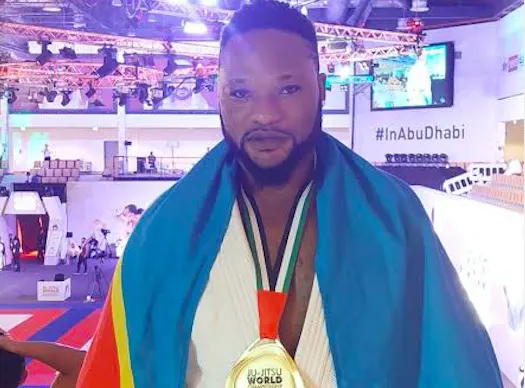
Sport News Africa: Christophe Mputu, you have made history in Congolese jiu-jitsu by giving the DRC its first world title. How does it feel?
Christophe Mputu : It's a great honour for me. It's a dream come true, thanks to my determination and my love for my work and my country. Despite the difficulties, I was determined to take my country to the top, and that's what happened.
You had an exceptional 2022, with titles won at both continental and international level. What's your secret?
2022 is an unforgettable year for me, with the African champion title and above all the world champion title. I also won a medal at the Paris Grand Prix. It shows that nothing was handed to me, just a run of good results that I achieved thanks to the seriousness I put into my work.
"It was really tough, I was on my own, with no doctor and no coach. In those conditions, it was almost impossible to get a positive result. But I had a very strong mentality."
Did you receive support from the Congolese state?
Sadly not, the government abandoned me, I didn't receive a single franc from them. I did everything through my own efforts, at both the African championships and the world championships. But despite all the difficulties, I had a goal to achieve. Today the country is proud of me, and I hope this will finally make the government think of me.
How were you able to cover the costs of taking part in the world championships without any government funding?
It was really tough, I was on my own, with no doctor and no coach. In those conditions, it was almost impossible to get a positive result. But I had a very strong mentality. The other African delegations were fully staffed, but I was on my own in my corner, abandoned and with no resources. I couldn't bring a doctor or a coach with me, and I was completely alone throughout the competition. The other athletes felt sorry for me; they asked me lots of questions to find out why I was alone. There was nobody to look after me, but I was determined to win and I did it.
Can you tell us about your beginnings in jiu-jitsu?
It was more than 20 years ago. I started out in karate, then moved on to jiu-jitsu. I started doing the sport in Kinshasa before going to the province of Central Kongo. I am among the pioneers of jiu-jitsu in Central Kongo province. I also started practising judo in Central Kongo before going to Europe in 2002.
"When I arrived in Belgium in 2002, the Belgians saw that I had a great deal of talent; they then offered me the chance to change nationality. But I refused."
What happened when you arrived in Europe?
When I arrived in Belgium in 2002, the Belgians saw that I had a great deal of talent; they then offered me the chance to change nationality to represent Belgium in competitions. But I refused and kept my Congolese nationality. Even so, the Belgian sports officials sent me to competitions, but every time I won, I always carried the DRC flag. That caused me a lot of trouble with the people who were helping me to compete. They stopped supporting me because I kept refusing to take Belgian nationality. At that time, the DRC I was representing still hadn't done anything for me. So I started funding myself to go to competitions and I kept winning medals. Even so, I never received so much as a phone call from the Congolese officials. And at the last world championships, I was determined to win gold to raise my country's flag high, so that perhaps someone would finally take an interest in me. I did it.
Since you arrived in Kinshasa after your title, have you been received by any Congolese official?
Yes, I was received by the Sports Minister, Serge Nkonde, and we had a discussion.
Are you satisfied with your career?
Lots of people may only have discovered me after the world title, but I started bringing honour to my country a very long time ago. I have won more than fifty medals for the DRC in different competitions throughout my career. I'm very proud of that. As long as I stay strong, I will keep winning medals for my country.
Masiala JONATHAN