
Congo fencing: the épée still struggling to hit the mark
Fencing: With no subsidies and a shortage of equipment, fencers in Congo-Brazzaville are struggling.
Sport News Africa · Author profile ·
Listen to this story
Audio version in preparation · read aloud by your browser meanwhile
“At last, fencing in a newspaper!” exclaims Grâce Soukissa, a sales agent at a newspaper, as he reads an article on fencing in an old issue. And with good reason: “I don't hear much talk about fencing in our media, not with the same frequency as abroad”, he continues.
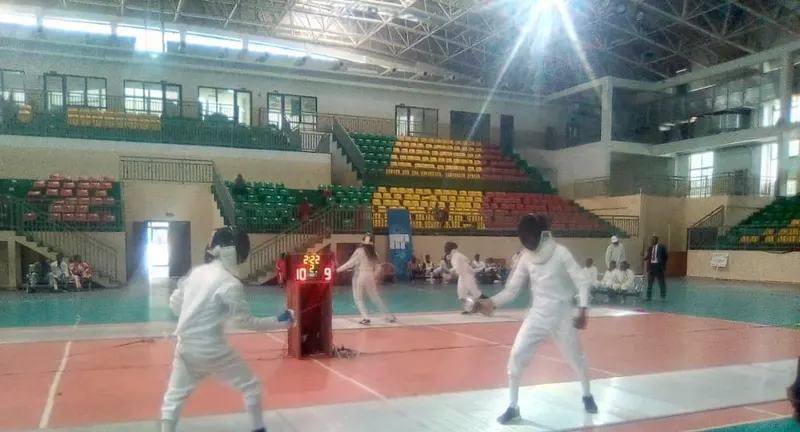
Yet last March in Pointe-Noire, the “Aigle royal” tournament took place. Launched by the club of the same name, based in Pointe-Noire, the competition brought together athletes from every corner of Congo, as well as from foreign countries, including the DRC.
And while waiting for the national championship scheduled for August, the country is preparing to host, next June, the second edition of the Albert Kaya international tournament, launched in 2021 in memory of the first president of the Congolese Fencing Federation (FECOES), who died in January 2020.
Making do with what they have
While this calendar seems to be going unnoticed by the Congolese public, officials have a ready explanation. There is a real problem in popularising fencing. “Quite clearly, it's as if fencing didn't exist in Congo. But that is symptomatic of the difficulties we face in organising our activities”, admits Gaël Diamoneka, national technical director at FECOES.
The main difficulty is financial. And if the purse is often empty, it is chiefly down to a lack of subsidies. “The ministry used to provide subsidies. But since 2016, the federation has received none. We get by on meagre resources from membership fees and a few rare sponsors. But it isn't enough”, Diamoneka continues.
The result: “We make do with what we have, because we don't have substantial budgets. So it's hard to fund promotional work such as advertising or a heavy media push. That's why we struggle to equip the athletes, because the equipment (épées, protective gear, etc.) is expensive”, the technical director explains further. “And all this means fencing in our country is little known, or not very well known”.
“We try to forget this hardship”
The difficulties are far from sparing the athletes. “To get to training, you have to spend at least 2000 CFA francs (about 4 euros) on taxi transport. Yet fencing here has no professional status. Athletes have to fend for themselves. It discourages and demotivates sportspeople”, laments Julia Dianzenza, reigning Congo women's épée champion and gold medallist at the first Albert Kaya tournament.
Even so, Dianzenza says she is determined to win the second edition of the Albert Kaya tournament and retain her national title. “As a physical education teacher, practising sport is above all a matter of passion for me. That's why we try to forget this hardship. It allows us to keep moving forward”, vows the 2015 African Games medallist in Brazzaville.
State support sought
Moving forward, certainly, but by encouraging more Congolese to love the sport. “We promote fencing by talking with pupils in schools. And children are gradually becoming interested in the sport”, says Gaël Diamoneka.
The athletes are doing their bit too. “That's what I try to do by teaching my pupils the different techniques and rules of fencing. I even teach my own child fencing. It's my way of spreading fencing across the country”, Dianzenza explains further.
Although FECOES is battling on as best it can, the governing body would still like to step up a gear. To do so, the State must provide the federation with the necessary resources. “All we ask of the authorities is to back us. After all, it's Congo that wins”, suggests Gaël Diamoneka.
But FECOES's difficulties are much the same as those of most sports federations in the country. And as with the other federations, there is nothing to guarantee for now that things will finally change in fencing.
John Ndinga-Ngoma