
Congo football: keepie-uppies as a pastime and a way to get by
Keepie-uppies are becoming increasingly common in Congo-Brazzaville, with a number of people taking up the practice.
Sport News Africa · Author profile ·
Listen to this story
Audio version in preparation · read aloud by your browser meanwhile
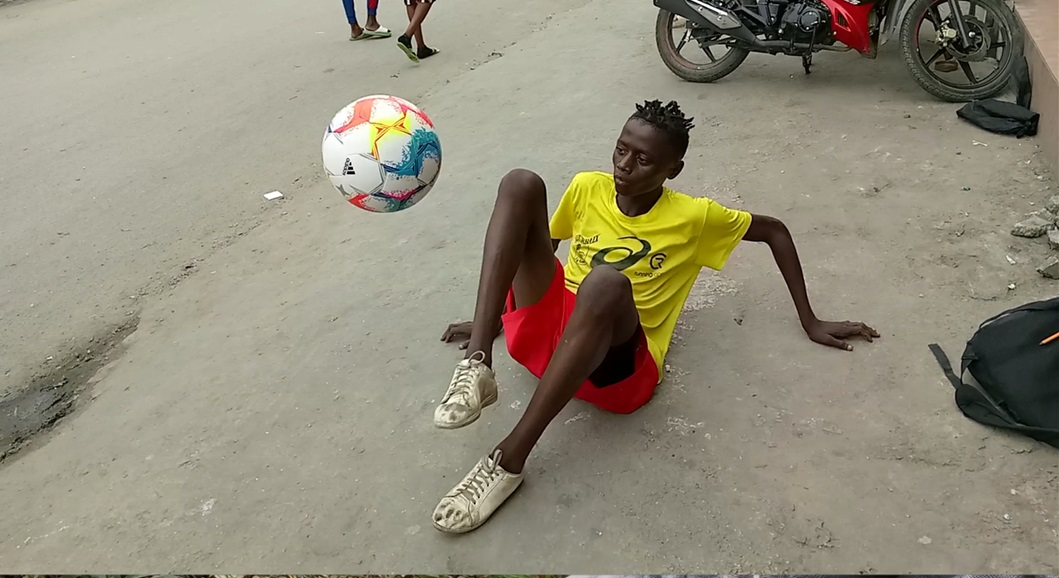
They call him the travelling footballer. Ekany Ngakosso is a young lad who, ball in hand, walks the streets and neighbourhoods of Pointe-Noire doing keepie-uppies. For the attacking midfielder, it is above all about staying in shape, a matter of sporting survival.
Ekany Ngakosso is not the only footballer juggling the ball in public in the Congolese economic capital. There are no official figures yet, admittedly, but observers believe the phenomenon is now well established in the city, as it is across the country. "The phenomenon is nothing new. Elsewhere in the world it is far more developed. But it is now that it is gaining momentum," says Pépin Herman Ékouakoubou, a sports journalist at a local radio station.
Pastime and livelihood
Several factors have encouraged the trend. In Pointe-Noire, as almost everywhere in the country, football is not professional, and clubs, especially those in the lower divisions, are struggling badly to function. That very often affects a player's fitness. And everyone has to get by in their own way.
"For me, keepie-uppies are much more a matter of sporting survival. I say sporting survival because training sessions at my club are not regular, for lack of resources. As a result, you sometimes lose certain qualities. So to stay in shape, I have to practise keepie-uppies," says Ekany Ngakosso.
Congo-Brazzaville also has a shortage of leisure centres. Faced with that reality, keepie-uppies have become the plan B to meet the need for recreation. "I am a pupil in the local 5e class. Yes, I go to the library. But I can't spend the whole day reading! The logical thing would be, after school activities (lessons, reading, etc.), to go and unwind. But leisure centres are scarce," laments the young attacking midfielder.
There are financial motives too. "As you can see, I come to juggle here (Pointe-Noire central market, editor's note) with a small basket. I don't force spectators to leave anything in it. But anyone can make a gesture of their own free will. My parents are destitute. I am 25 years old, I don't work and I no longer go to school. Rather than go and steal, I come to juggle. And it lets me feed my partner and our son, who is now two years old. So it's my livelihood until I find a good job," says another juggler, who preferred to remain anonymous.
Encouraging talent by creating facilities
For their part, many spectators do not hesitate to make that gesture. "It's about encouraging young talent. Maybe one day they will have the best conditions to express their talent freely and fully. That's why I always give them a note or a coin. I have no favourites, I give to all the jugglers who perform in front of my shop and I will keep doing so as long as they come past here," says Abou Moussa, a clothes trader at Pointe-Noire central market.
Meanwhile, talents are fading into obscurity. "Keepie-uppies don't make you a good player. You can juggle well, but if you can't shake off a marker, if you can't give your team-mates options with successful passes and dribbles, you are nothing. So we expect these youngsters on the pitch rather than in the markets and the streets," says Pépin Herman Ékouakoubou, a sports journalist at a local radio station.
Read also: Football: in Congo, professionalisation put to the test by the transition
Human rights advocates say it is high time the authorities took appropriate measures. "As I speak, humanity is celebrating World Children's Day under the theme 'For every child, every right' (20 November, editor's note). But among those rights, the most fundamental are education and leisure, as you can read in the International Convention on the Rights of the Child. The State would do well to build leisure centres and sports facilities so that our little ones can express their talent. Otherwise, we will remain witnesses and extras at the big football events, " says Fabrice Sévérin Kimpoutou, a human rights advocate.
John Ndinga-Ngoma