
FIFA WC 2026: Should Africa boycott World Cup in US?
A few months before the start of the 2026 World Cup, an idea long considered unrealistic begins to settle in the public debate: that of a boycott of the competition. In Africa as in Europe, this hypothesis is fuelled by the policy of US President Donald Trump, particularly on migration and diplomatic issues. Can the 2026 World Cup still claim to embody the universality of football?
Philemon MBALE · Author profile ·
Listen to this story
Audio version in preparation · read aloud by your browser meanwhile
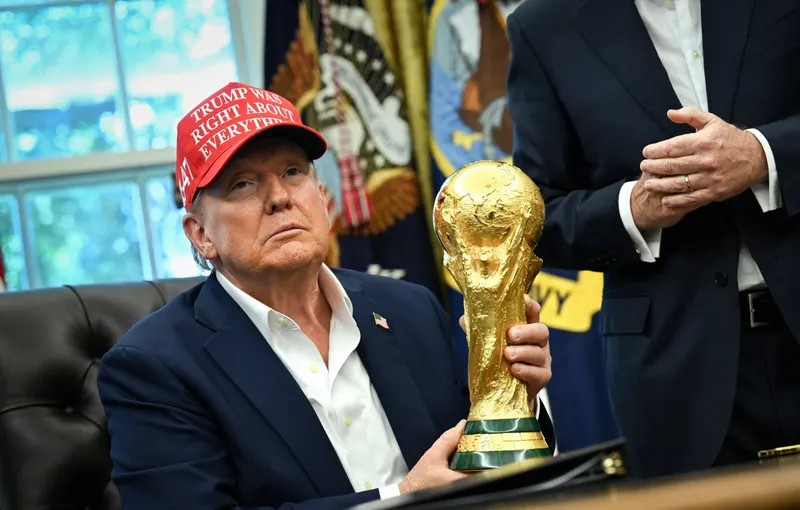
A succession of decisions made by the US administration has raised global concerns as to the FIFA World Cup 2026 to be hosted by the USA, Mexico and Canada. First, the imposition of a bond of up to $15,000 for visa applicants from certain countries. Then, a few days later, the announcement of the suspension of long-stay visas for nationals from 75 countries, among which are 15 nations qualified for the 2026 World Cup.
Africa appears to be the region hardest hit. 8 of its 9 representatives are affected by these restrictions: Algeria, Egypt, Tunisia, Morocco, Ghana, Ivory Coast, Senegal and Cape Verde. A situation that immediately raised the fear of a de facto ban on African fans on American soil.
FIFA has also reminded that the possession of a stadium ticket does not constitute a guarantee of entry into the United States. If the US Department of State specifies that these measures only concern, at this stage, immigration visas and not tourist visas, uncertainty remains for supporters.
Qualified national teams are not expected to encounter major obstacles to enter the US. Supporters, on the other hand, remain subject to an uncertain administrative process, sometimes a deterrent. This dissociation raises a fundamental question: can we organize a World Cup without guaranteeing the presence of the people who accompany their teams?
On social media, many African citizens have begun to evoke the idea of a boycott by the selections concerned, not as a clearly defined institutional strategy, but as a symbolic response to what they perceive as an inequality of treatment.
This reflection took on another dimension when a renowned football personality publicly positioned himself. Claude Le Roy, former coach of several African teams, openly mentioned the boycott option. In the columns of Le Figaro, he criticized the American posture:
"I wonder if we should not call for a boycott of the 2026 World Cup, given Donald Trump’s behavior towards the African continent, with a FIFA president who claims to be by his side. The leaders at the highest level of football never talk about football anymore but only about money.”
An output that has found a particular echo in Africa, where Claude Le Roy enjoys a strong historical legitimacy.
In Europe, a boycott for diplomatic purposes is optional
In Europe, the drivers of the debate are different. In Germany in particular, the idea of a boycott is gaining ground among some public opinion and the political class, in response to US threats concerning Greenland and trade tensions with the European Union. A poll commissioned by the newspaper Bild indicates that 47% of Germans would approve a boycott of the competition in case of annexation of Greenland, compared to 35% who would oppose it.
Several political leaders mentioned this option as a pressure lever. The German Secretary of State for Sports, Christiane Schenderlein, however, recalled that the decision was up to the German Football Federation and FIFA, stating that the federal government "would accept this assessment".
Sepp Blatter questions the choice of host country
The debate reached a new level with the statement of Sepp Blatter, former FIFA president. On Monday, he supported the idea of a boycott by supporters of matches played in the United States, echoing the remarks of Swiss expert Mark Pieth. In an interview with the newspaper Der Bund, the latter estimated that
"there is only one advice for fans: stay away from the United States".
Blatter repeated this argument on X, considering it legitimate to question the organization of the tournament in such a political context.
African fans, between anger and resignation
On the ground, concerns are concrete. Questioned by the Associate Press, Djibril Gueye, a Senegalese fan, wonders:
"I don’t understand why the American president would want certain teams not to participate. If that’s the case, the US should not host the World Cup.”
Same uncertainty for Fatou Diedhiou, president of a group of Senegalese supporters.
"We want to participate, but we don’t know how. For now, we are waiting"
she says.
Others, like Sheikh Sy, display their determination to accompany their selection at all costs, recalling that Senegalese supporters have always followed their team around the world.
Franck Kessié calls for a political solution
On the Ivorian side, the captain of the Elephants, Franck Kessié, called for an institutional response rather than a sports break.
''There is an events committee managed by the Ivorian Football Federation. With the government, we will put things in place to make it easier for our supporters,"
warned the midfielder. A stance that illustrates the embarrassment of African football players, caught between popular attachment and diplomatic realities.
Boycott or political pressure?
At this stage, no African federation nor CAF has officially called for a boycott of the 2026 World Cup. A collective withdrawal seems neither sportively nor economically credible. But the multiplication of positions reveals a deeper malaise: that of a globalized football which struggles to reconcile security logics, geopolitical issues and popular dimension.
A World Cup under high tension
Thought of as an opening tournament with its format expanded to 48 teams, the 2026 World Cup could become one of silent exclusions. For Africa, the question may not be so much one of boycotting as it is to have a substantive debate: can we organize the biggest celebration in world football without guaranteeing equitable access to all its supporters?
A few months before the kick-off, the response is still not clear-cut. But the alarm signal is indeed launched.