
Paris 2024 — Ismaël Alhassane: “Experiencing the Games with my brother is incredible”
Qualified for the 2024 Olympic Games, Nigerien judoka Ismaël Alahassane will travel to Paris with his coach and older brother, Abdou.
Sport News Africa · Author profile ·
Listen to this story
Audio version in preparation · read aloud by your browser meanwhile
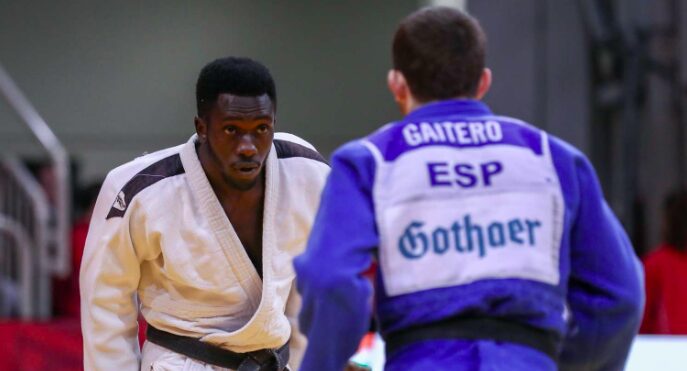
“When I was little, he challenged me: ‘Do more than I did!’ I told him, all right, I’ll do even more.” Ismaël Alhassane laughs. After a long day of training, the judoka tells the story of a career intertwined with that of his brother, Abdou. “He was a role model, of course”, he admits. “But I didn’t start with judo. I played football as a child. I was a technical attacking midfielder (smiles). When I was in the final year of primary school (CM2), my family wanted to send me to an academy in Ghana. But there were problems with continuing my schooling there, so they decided against it.”
Remaining in Niger, Ismaël discovered the dojos and his brother’s passion for the sport. Abdou taught him the basics. A former national champion and three-time African medallist (silver in 2005, bronze in 2004 and 2006), Abdou Alassane became the first Nigerien judoka to qualify for the Olympic Games. Beaten in the round of thirty-two and then in the repechage by Spain’s Oscar Penas, he nevertheless inspired many youngsters in Niamey, including his younger brother. “I did everything I could to surpass him”, Ismaël laughs. “I trained every day, often at a different club each time, following a special programme. I had a goal in mind, so I wasn’t going to give up.”
“There were nights when I couldn’t sleep because my body hurt ”
A pioneer for the sport on the international stage, Abdou moved straight into coaching after retiring from competition. A respected figure, he guided promising Nigerien athletes such as Ahmed Goumar, who qualified for Rio in 2016. “We lack resources, but we have talent”, Ismaël says. “There is a judo culture in Niger with many good athletes. After taekwondo, judo is probably the most developed martial art in our country.”
Thanks to Issoufou Alfaga, a silver medallist in Rio and world champion in 2017, taekwondo has built an unrivalled reputation in Niamey. However, the consistency of Nigerien judokas has helped clubs and dojos spring up across the capital, giving structure to a sport that attracts an increasing number of participants. “Training at home has never held me back”, Ismaël insists. “On the other hand, experiences abroad and travelling have allowed me to discover other things.”
Having become one of Africa’s leading competitors in the under-66-kilo category, like his brother, he won bronze at the African Open in Yaoundé in 2019. More medals followed in subsequent years (gold at the African Open in Dakar in 2022, silver at the African Open in Abidjan in 2024). “I sacrificed a lot to get this far. People never see what we go through day to day. To them, if you’ve failed, you’ve failed. They don’t realise the injuries, the nights when I couldn’t sleep because my body hurt, the times when I had to train three times a day and was already on the road at 6 in the morning. All that effort, living far away from my family, from my loved ones…”
The bitter disappointment of Tokyo
At the Tokyo Games, Ismaël was the only judoka among the seven Nigerien athletes who had qualified. It was inevitably a unique moment in his career, all the more so in Japan. “The pressure was huge, really huge”, he admits. “Representing an entire country, flying its flag so high… My coach told me it would be something else, that there was no comparison. Yet I had competed in every world championship. He kept telling me that the Games were different, that they were nothing like anything else.”
Facing France’s Kilian Le Blouch in the first round, Ismaël Alhassane lost with nine seconds remaining after receiving a third shido (editor’s note: a penalty), which meant defeat. “It was very, very close… I didn’t feel I was inferior. But mentally, it was a different kind of contest. At times he refused to engage, and the referee gave me a shido that I thought should have gone to him. It wasn’t easy to pick myself up after that experience. I was gutted.”
After a quiet period, the Nigerien returned to the mats and secured a scholarship to improve his training in France, following a spell of almost three months in Hungary. “Along with other African athletes, we benefited from a training camp in Budapest, near the International Judo Federation. Then I had this opportunity to come to France. It was very important for my preparation and, above all, for improving my technique.”
No more visa problems
At the Centre Régional Jeunesse et Sport Petit-Couronne, he has a French coach as well as his brother, who has remained at home to look after Niger’s emerging talents. “He’ll be there for the Games”, he smiles. “It’s an enormous source of pride, especially for our parents. Since I’ve been living away, we call each other every day. Even though it hasn’t always been easy, it was worth it. I overcame the doubts, the fact that I couldn’t go to the African championships in Morocco last year because of a visa problem when Niger’s borders were closed… And then, finally, to return this year and qualify for Paris is incredible.”
Better prepared and no longer having to lose the necessary weight three or four days before the crucial weigh-in — “we used to do it that way, but it wasn’t good for our health” — Ismaël Alhassane now intends to surpass his older brother by becoming the first Nigerien judoka to win a contest at the Games. It would fulfil the promise he made as a child in a Niamey dojo.