
Legends: five things Samuel Eto’o and Yaya Touré have in common
Sons of Cameroon and Ivory Coast, Samuel Eto’o and Yaya Touré are two icons of African football who share five similarities.
Sport News Africa · Author profile ·
Listen to this story
Audio version in preparation · read aloud by your browser meanwhile
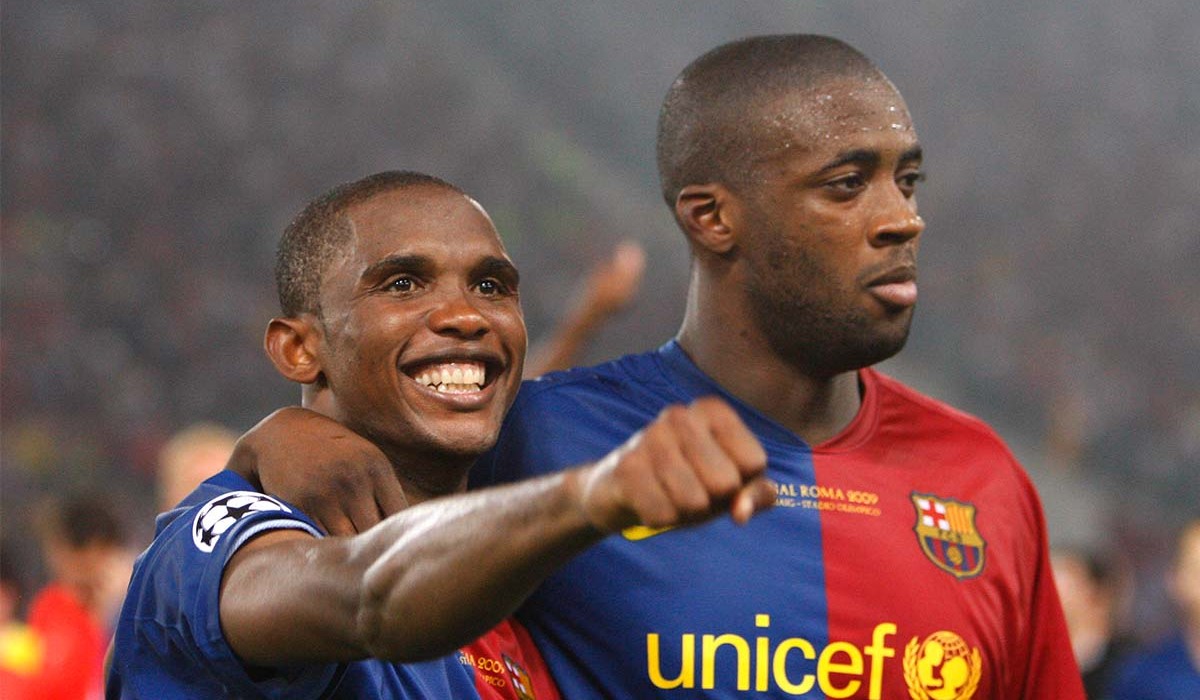
Samuel Eto’o and Yaya Touré. This is the story of two great figures whose names are written in gold in the annals of African football. They are often set apart on the pitch by nationality [one is Cameroonian, the other Ivorian] and position [one was a striker, the other a midfielder], yet these two emblematic players share several defining aspects of their careers. From their record hauls of African Ballons d’Or to their roles as national captains, via their Africa Cup of Nations successes and their time at FC Barcelona, here are five notable similarities that link these football legends.
A record number of African Ballons d’Or
It is one of history’s little quirks. The Ballon d’Or has no owner. But in Africa, Samuel Eto’o and Yaya Touré have shared the top of the roll of honour for a very long time. Each man has won the supreme award four times. And the man who set the record is... Eto’o. A prolific scorer in the 2000s, the former Indomitable Lion won his first trophy at the 2003 CAF Awards. He then completed a hat-trick with wins in 2004 and 2005, but had to wait until 2010 to lift his last Ballon d’or. It came just in time, before the undisputed reign of one Yaya Touré began. The former Ivorian midfielder was named best African footballer in 2011, 2012, 2013 and 2014. Since then, fate has refused to separate the two stars.
Captaincy: the armband that caused trouble
As leading figures in their respective national teams, Eto’o and Touré both captained their countries. But it was not without controversy. Samuel Eto’o took the Indomitable Lions armband in 2009 in a friendly against Austria, marking the beginning of the end for the emblematic Rigobert Song. The change of armband-holder bred a certain "enmity" between the two men. It went as far as dividing the Indomitable Lions dressing room at the World Cup and the 2010 AFCON. It took a crisis meeting at the Prime Minister’s offices in September 2012 to bring the rift to an end.
For his part, Yaya Touré inherited the Elephants armband at the 2014 World Cup. He was captain in the first two games, much to the annoyance of Didier Drogba, an even more iconic player, who started on the bench. The coach’s decision helped divide fans of the two players and further strained the already tense relationship between the two men, who had been locked in a sort of battle of egos for a year already.
Winners of at least one Africa Cup of Nations
Eto’o and Touré both left their mark on the history of the Africa Cup of Nations (AFCON) by winning it. Eto’o lifted the trophy twice (in 2000 and 2002), while Touré had to wait until 2015, in Equatorial Guinea, to become a champion. It was the Elephants’ second title, but the first for a golden generation that was already tired of waiting.
Triumphs at Barça and a historic sextuple
Eto’o joined FC Barcelona in 2004, followed by Yaya Touré three years later. Together, in the colours of the Catalan club, they helped win a historic sextuple in the 2008-2009 season. That year, Barcelona won six trophies: the Champions League, La Liga, the Copa del Rey, the Club World Cup, the Spanish Super Cup and the UEFA Super Cup. It was an unprecedented feat in the history of football and of the club.
International retirement at 33
Throughout his career, Samuel Eto’o often left doubt hanging over whether he needed to retire from his country’s national team. But his final decision came after the World Cup in Brazil in 2014. The Cameroonian striker then announced his international retirement at 33. Curiously, Yaya Touré also retired from international football at that same age, on 20 September 2016, announcing it on social media.
Arthur Wandji