
The 10 most remarkable African performances at the Olympic Games
Sport News Africa looks back at 10 performances that let Africa shine at the Olympic Games.
Sport News Africa · Author profile ·
Listen to this story
Audio version in preparation · read aloud by your browser meanwhile
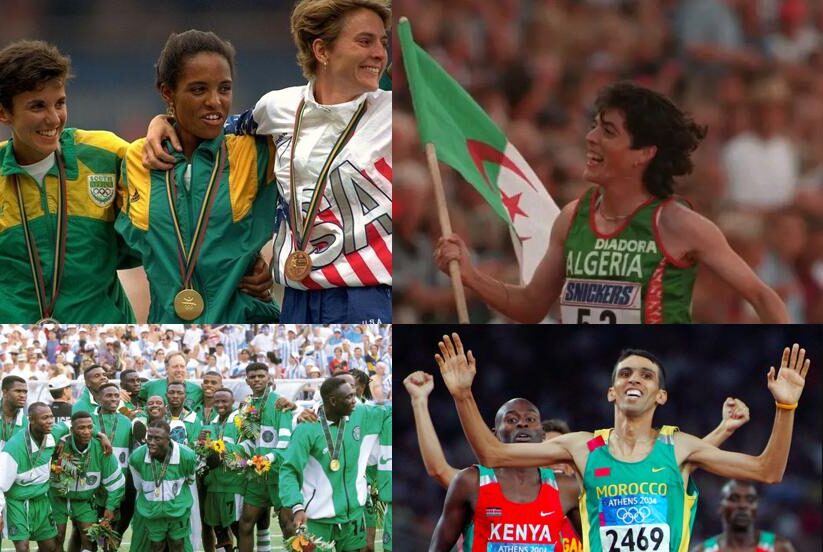
Derartu Tulu (Ethiopia) - Barcelona 1992
Derartu Tulu is a trailblazer. The Ethiopian became the first sub-Saharan African woman to win an Olympic gold medal, taking the 10,000 metres in Barcelona in 1992. She faced renowned runners, notably South Africa's Elana Meyer, whom she beat with a tactical race and a final sprint that is still remembered. Tulu, an outsider at the time, sprang a surprise and her triumph united the African continent in celebrating a historic feat. After her victory, she ran hand in hand with Meyer, symbolising the end of apartheid and racial unity, a gesture widely applauded around the world.
Eric Moussambani (Equatorial Guinea) - Sydney 2000
Nicknamed "Eric the Eel", Eric Moussambani became famous in spite of himself for his performance in the 100 metres freestyle in Sydney in 2000. Having learned to swim only a few months before the Games and having never seen a 50-metre Olympic pool, Moussambani swam alone after his two opponents were disqualified for false starts. Although he recorded the slowest time in Olympic history (1:52.72), his persistence and determination inspired millions of people. His performance, initially mocked, was ultimately celebrated for its sporting spirit and helped promote swimming in Equatorial Guinea.
David Rudisha (Kenya) - London 2012
David Rudisha dazzled the whole world at the London Games in 2012 by setting a new 800 metres world record with a time of 1:40.91. Up against rivals each more formidable than the last, such as Uganda's Timothy Kitum and American Nick Symmonds, Rudisha was the favourite and lived up to his billing. His race was described as one of the best in Olympic history, with every runner in the final setting a personal or national record. Rudisha's victory consolidated Kenya's dominance in middle-distance running and was greeted with immense national pride.
Nigeria football team - Atlanta 1996
A golden generation reached the summit of Olympus. Nigeria won gold at the Atlanta Games in 1996, beating Brazil in the semi-final and Argentina in the final. It was a resounding run from the band of Taribo West and Nwanko Kau, who swept aside everything in their path. Though considered outsiders at the start of the tournament, the Nigerians, thanks to an exceptional generation of talented players, surprised the whole world, marking a turning point for African football and helping shed the inferiority complex that African nations had harboured towards the rest of the world. Their triumph generated immense pride in Nigeria and inspired a new generation of footballers.
Also read: 2024 Olympics: four African nations expected to shine
Haile Gebrselassie (Ethiopia) - Sydney 2000
Already the master of the discipline, Haile Gebrselassie wrote himself further into history by adding a second Olympic gold medal to his honours list, winning the 10,000 metres in Sydney in 2000, having already triumphed in Atlanta in 1996. He beat his main rival, Kenya's Paul Tergat, in a dramatic race decided in the final metres. The favourite for the event, Gebrselassie enhanced his legend and inspired an entire generation of Ethiopian runners, who continue to shine in global long-distance running and rival the Kenyans.
Hicham El Guerrouj (Morocco) - Athens 2004
The Athens Games in 2004 were a defining moment for him. Winning two gold medals, in the 1500 metres and the 5000 metres, the Moroccan became the first man to achieve that historic double since 1924. El Guerrouj, the favourite thanks to his impressive record of success on the world stage, beat formidable opponents such as Bernard Lagat and Kenenisa Bekele, heavyweights of long-distance running, at a highly competitive Games. His performance was hailed as one of the greatest feats in athletics and he became a national hero in Morocco.
Cameroon football team - Sydney 2000
It is impossible to talk about Nigeria in 1996 without mentioning Cameroon in 2000. The Indomitable Lions won gold in the men's football at the Sydney Games in 2000, beating Spain in the final. Led by players such as Samuel Eto'o, the team won after a penalty shoot-out, marking another great moment for African football. Considered favourites after dominating the Africa Cup of Nations, Jean-Paul Akono's men lived up to their reputation as giants of African football with this Olympic victory.
Chioma Ajunwa (Nigeria) - Atlanta 1996
While the Super Eagles' triumph is more often discussed, history will remember that it was Chioma Ajunwa who brought Nigeria its first Olympic gold medal in athletics. In the long jump, she stood out with a leap of 7.12 metres. It was a mark that let her stun the opposition, with Fiona May and Jackie Joyner-Kersee among those left to settle for the minor places. Returning from a doping suspension, Ajunwa was not expected to enjoy such a success. But she defied expectations to triumph. Her victory was a moment of immense pride for Nigeria and inspired many Nigerian athletes, including a generation who later specialised in the sprint.
Kenenisa Bekele (Ethiopia) - Beijing 2008
Beijing 2008 was definitely his moment. Kenenisa Bekele dominated the long-distance events on Chinese soil, winning gold in the 5000 metres and 10,000 metres and setting Olympic records in both races. Yet he faced serious opposition, such as ileshi Sihine and Eliud Kipchoge, who has since become the benchmark in the marathon. The favourite given his previous successes and his season, Bekele confirmed his supremacy in long-distance running, enhancing Ethiopia's reputation in these events.
Hassiba Boulmerka (Algeria) - Barcelona 1992
Anyone who mentions Algeria and the Olympic Games cannot overlook Hassiba Boulmerka. She was the first Algerian woman to win an Olympic gold medal, taking the 1500 metres in Barcelona in 1992. She did so against rivals such as Lyudmila Rogachova and Qu Yunxia and, above all, after receiving death threats because she ran in shorts. Despite all the obstacles, Boulmerka triumphed, becoming a symbol of progress and emancipation for women in the Arab world. Her victory was celebrated as a major step forward for women's rights and for sport in Algeria.