

Oklahoma City redistribute the roles around their core players
Oklahoma City keep their core but reshuffle their perimeter rotation. Dated roster, projected starting five, strengths, risks and the Thunder's first game.
Listen to this story
Synthetic English voice · 6 min 19 s
Oklahoma City have kept Shai Gilgeous-Alexander, Jalen Williams and Chet Holmgren, but part of the supporting cast has changed. With Luguentz Dort, Isaiah Joe and Aaron Wiggins gone, Mark Daigneault must redistribute roles on the perimeter. The Thunder still have the means to chase the title; their new rotation must show how it will defend and create when the first options are contained.
Starting point: 64 wins, then a lost conference final
The 2025 to 2026 regular-season record remains that of a top-tier team: 64 wins, 18 defeats and first place in the Western Conference. Oklahoma City scored 119.0 points per game and conceded 107.9. That margin of 11.1 points points to sustained dominance, though it does not on its own capture the difficulties of a playoff series. The run ended in the Western Conference finals, in a seventh game against San Antonio.
Daigneault therefore keeps a solid base rather than a group to be rebuilt from scratch. The challenge is more specific: preserve the strengths of the core while replacing several players who filled different roles. A lead perimeter defender, a shooter and a versatile connector are not necessarily replaced by the same player.
per game
per game
per game
per game
The moves: a new split of perimeter minutes
Dort and Aaron Wiggins have joined Atlanta, Joe has headed to Detroit and Branden Carlson to Portland. Aday Mara, Bennett Stirtz and Otega Oweh arrive through the draft. Mara adds a young centre, Stirtz a ball-handling option and Oweh a perimeter profile to develop. These arrivals do not guarantee immediate minutes: their place will depend on the line-ups chosen and on how quickly they adapt.
Jared McCain is also an option in this reshuffle, but he should not be mistaken for a summer signing: he arrived in February 2026. With Ajay Mitchell and Cason Wallace, he can offer more solutions with the ball. The question will be who plays alongside Gilgeous-Alexander, and then who runs the offence when the point guard leaves the floor.
- →Aday MaraAday Mara · 2026 draft
- →Bennett StirtzBennett Stirtz · 2026 draft
- →Otega OwehOtega Oweh · 2026 draft


- ←Luguentz Dort · Atlanta
- ←Aaron Wiggins · Atlanta
- ←Isaiah Joe · Detroit
- ←Branden Carlson · Portland
The scoring of the three key players



Per-game averages, 2025–26 regular season. Three selected key players, not an exhaustive ranking of the squad. Samples differ.
Gilgeous-Alexander the primary creator; Williams and Holmgren key links
Shai Gilgeous-Alexander
Gilgeous-Alexander finished the 2025 to 2026 regular season averaging 31.1 points, 4.3 rebounds and 6.6 assists per game over 68 appearances. That output gives the offence a concrete starting point. Our reading of the task is to supply him with support before defences force a possession that depends entirely on his final move. Moving the ball, finding him again after a relocation or letting a team-mate attack a mismatch are possibilities to watch, not routines already in place.
Jalen Williams comes off 33 regular-season games, averaging 17.1 points and 5.5 assists. He can provide a second initiator and attack the space opened up by his point guard, without assuming a full season at that level. Holmgren offers a different geometry: his presence near the rim and his ability to step away from it can alter opposing help defence. Isaiah Hartenstein keeps a different function, more tied to screens, hand-offs and interior presence. The value of these profiles will lie in offering several answers to the same defence.
2025–26 regular season. These figures describe the past season and do not predict those of the coming season.
The projected starting five and the bench options
Our season projection pairs Gilgeous-Alexander, Wallace, Jalen Williams, Holmgren and Hartenstein. This is an SNA hypothesis, subject to availability, and not a starting five announced for the opener. Wallace would take on greater responsibility against the opposing ball-handler; Jalen Williams would share the creation; the two bigs would bring complementary functions around the rim.
Alex Caruso, Mitchell, McCain and Jaylin Williams offer alternatives for the second unit and for closing games. Caruso can strengthen defensive pairings; Mitchell and McCain can take possessions on their own; Jaylin Williams is another interior option. Kenrich Williams makes it possible to change the size of certain line-ups. The youngsters, including Mara and Stirtz, will have to earn their place in this group. The bench hierarchy remains a projection of roles, not a promise of playing time.
Bench relays — projected roles
Unofficial season projection; neither a guaranteed opening line-up nor a final pecking order.
The three-point shooting of the three core players
2025–2026 regular season. Three selected players with at least ten games and one attempt per game. Team benchmark: 36.5%. Past shooting accuracy does not predict 2026–2027.
The roster as updated on 20 October 2026
The group recorded on 20 October 2026 comprises 17 players. The roles below are meant to help read the possible pairings; they are neither a rotation hierarchy nor an official line-up. Unavailable players remain included in the roster.
17 players
| Player | Status | Pts | Reb | Ast | 3PT |
|---|---|---|---|---|---|
| Point guards and guards | |||||
| Shai Gilgeous-Alexander | 31.1 | 4.3 | 6.6 | 38.6 % | |
| Cason Wallace | – | – | – | – | |
| Ajay Mitchell | – | – | – | – | |
| Jared McCain | – | – | – | – | |
| Alex Caruso | – | – | – | – | |
| Bennett Stirtz | – | – | – | – | |
| Nikola Topić | – | – | – | – | |
| Josh Dix | Two-way | – | – | – | – |
| Otega Oweh | Two-way | – | – | – | – |
| Forwards and utility players | |||||
| Jalen Williams | 17.1 | 4.6 | 5.5 | 29.9 % | |
| Kenrich Williams | – | – | – | – | |
| Brooks Barnhizer | Two-way | – | – | – | – |
| Bigs | |||||
| Chet Holmgren | 17.1 | 8.9 | 1.7 | 36.2 % | |
| Isaiah Hartenstein | – | – | – | – | |
| Jaylin Williams | – | – | – | – | |
| Thomas Sorber | – | – | – | – | |
| Aday Mara | – | – | – | – | |
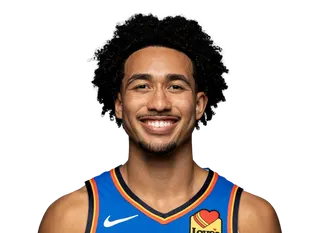



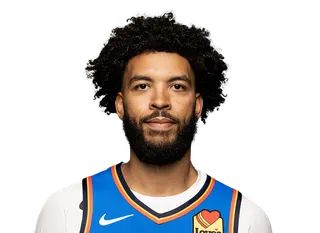
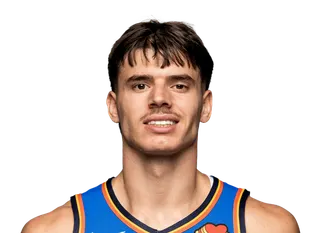


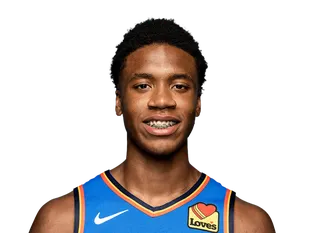
Roster recorded on 20 October 2026. Roles are not exclusive; being in the squad guarantees neither availability nor playing time. The medical points in the story keep their recorded dates. Grouped by role; versatile profiles. 2025–2026 averages for the three documented core players; "–" = data not verified here.
Compared with the training-camp group first presented, Christoph Tilly no longer features in this roster.
Strengths and risks: keeping the stops, finding new links
The Thunder can lean on the continuity of their core and on several combinations of size and mobility. The defensive challenge will be to spread the duties Dort leaves behind without multiplying the help that frees up a shooter. Effective first-line pressure can keep the bigs better positioned; conversely, a duel lost too early can drag the whole defence out of shape.
The offensive risk lies in possessions where the first advantage disappears. The departures of Joe and Wiggins give other perimeter players more responsibility. The quality of the shots created and the decisions after the first pass should be tracked, rather than drawing conclusions from one night of shooting. Stretches without Gilgeous-Alexander will be another test of how responsibilities are shared.
The anchor points
- The core of key players remains in place.
- Several creative options.
- Complementary interior pairings.
The work in progress
- Redistribute the perimeter defensive assignments.
- Create after an initial advantage is contained.
- Build sequences without Gilgeous-Alexander.
The ambition: going all the way to the title
Aiming for the Finals and the title is an ambition consistent with the core that has been kept and last season's record. Our reading guarantees neither a standing nor a playoff run. The first indicator will be the new rotation's ability to maintain a solid collective defence while offering several ways to start the offence. The season will also give time to tell lasting solutions apart from pairings that only work against a particular opponent.
Aiming for the title is consistent; the new rotation must deliver its collective expression.
The retained core players provide a base. The sharing of responsibilities must confirm this ambition.
First regular-season date
Oklahoma City will open at San Antonio on 21 October at 2:30 Brazzaville time, which is the evening of 20 October in the United States. The Thunder then host Denver on 23 October at 2:30 in Brazzaville. These regular-season games are separate from the preseason. Find the first-game page, the Oklahoma City team page and the NBA schedule on SNA.

Wednesday 21 October 2026 at 02:30, Brazzaville time · match centre
- The team’s live schedule appears here.
Countdown to tip-off.