
Patrick Vieira and Senegal: Dakar-born coach faces a nation in a hurry
Born in Dakar, he left aged eight and went on to win the World Cup with France. Patrick Vieira, appointed in August and installed in September, now leads a Senegal side emerging from a summer of crisis. The Federation is reported to have handed him a four-year project, but the country expects wins from 11 November.
Contribution SNA · Author profile · · Updated 15/10/2026 11:08 UTC
Listen to this story
Synthetic English voice · 8 min 22 s
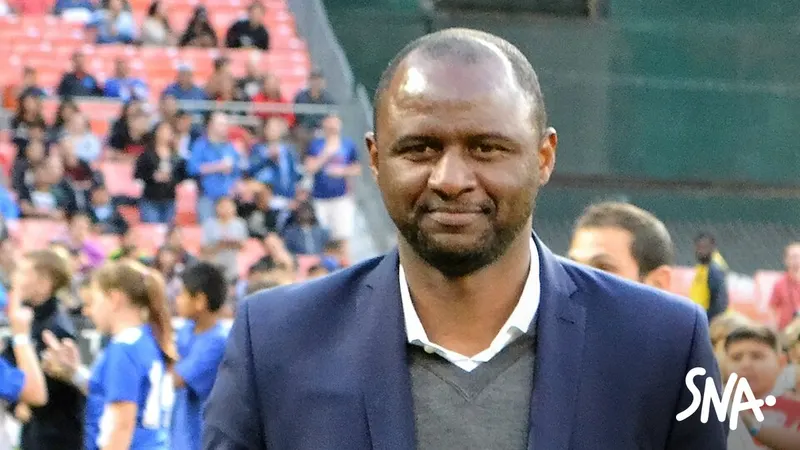
On 31 May 2002 in Seoul, Patrick Vieira ran the midfield for the France team. In the 30th minute, Papa Bouba Diop pushed the ball into the back of the net and Senegal, coached by Frenchman Bruno Metsu, beat the defending world champions 1-0. The Lions would go all the way to the quarter-finals. Twenty-four years on, the midfielder beaten that night sits on Metsu's bench.
“I was born here, my parents were born here and this is a homecoming,” Vieira said on 18 September in Dakar at his official unveiling. It is a fine phrase. It also says what the Senegalese Football Federation (FSF) went looking for: a global name, an intimate bond with the country, and the promise of direction after months of turbulence. What remains is to gauge what Senegal expects of him, and what his coaching record gives grounds to hope for.
Senegal's next match, against Sudan on 11 November, can be followed live on SNA: scorers, stats and line-ups.
From Dakar to Dreux, then Saly
Patrick Vieira was born in Dakar on 23 June 1976. He left Senegal aged eight for the Paris region, first Trappes, then Dreux, where he grew up. What followed belongs to French football: 107 caps for Les Bleus, the 1998 World Cup, Euro 2000.
The thread to his birth country was never cut, though. In 2003, he co-founded the Diambars institute at Saly, on the Petite-Côte, with former players including Bernard Lama and Jimmy Adjovi-Boco. An academy, not a shop window: a place that trains Senegalese players every day. That, perhaps more than his record in blue, is where his legitimacy in Dakar lies.
A summer of crisis, a two-stage appointment
The FSF's choice has to be read in the light of the previous ten months. On 18 January 2026, in Rabat, Pape Thiaw's Senegal beat Morocco 1-0 in the 2025 AFCON final, with a Pape Gueye goal in extra time. On 17 March, the CAF appeals board stripped the Lions of Teranga (hospitality, in Wolof) of the title. The reason given by the appeals board: the players had left the pitch for a time in protest at a penalty awarded to Morocco. The final was declared lost by forfeit, 3-0. The FSF has taken the case to the Court of Arbitration for Sport, which has set the hearing for 8 October in Lausanne. The date of the ruling is not known.
Then came the 2026 World Cup. One win in four matches, a 5-0 against Iraq, and an exit in the first knockout match, on 1 July: trailing 2-0, the Belgians won 3-2 after extra time. In mid-July, the FSF began dismissal proceedings against the coach and his staff.
On 18 August, the federation, headed by Abdoulaye Fall, elected in August 2025, announced Vieira on its social media and called it a “strategic choice”, according to AFP. The same day, according to Le Soleil, it said that talks on contractual terms “are continuing”. It would take a month for Vieira to be officially unveiled, on 18 September, a week before the first match in Maputo. His staff of ten, including three former Lions (Lamine Diatta, Abdou Kader Mangane and goalkeeping coach Khadim Faye), was only made public at the end of September.
The contract is said to run for four years, with two stated objectives: reaching the 2027 AFCON final and qualifying Senegal for the 2030 World Cup. Reported salary figures range from around 35 million CFA francs (€53,000) to 45 million CFA francs a month, without official confirmation. The FSF has not made these figures public.
Five jobs, no trophy
Senegal have not hired a novice. Nor have they hired a coach who has succeeded at everything, and the figures from his five jobs trace an uneven curve.
At New York City FC (2016-2018), he took his team to the MLS play-offs twice, without ever winning a round. At Nice, he finished 7th then 5th in Ligue 1, before being let go in December 2020 after five defeats in a row. At Crystal Palace, he finished 12th in the Premier League in 2021-2022, then was sacked in March 2023 after twelve matches without a win. At Strasbourg, a single season, ending in 13th place, and a departure in July 2024. At Genoa, finally, he took over in November 2024 a team sitting 17th in Serie A and secured survival with four matchdays to spare. The following season, he left on 1 November 2025, with the club bottom on three points after nine matchdays.
No national team job in that record. No title. And ten months out of the dugout between Genoa and Dakar.
The FSF's gamble, though, is played out elsewhere, in the dressing room. A group shaken by a final won then taken away, and by an early World Cup exit, may need an authority that is beyond question. That of a 1998 world champion, facing players who grew up watching him, can carry weight.
Vieira has also chosen to lean on the 2002 generation, the one that beat him in Seoul. Khalilou Fadiga attended his unveiling. “Their experience is important for this new generation of young players,” the national team coach said of the former internationals. El Hadji Diouf, his opponent in 2002, is not part of the technical staff.
His spell at Genoa, finally, showed that he knows how to turn round a poorly placed team quickly. That is what a national team demands, as it meets only for a few days every three months.
Time, what he lacks most
One question remains. Can a coach who has never lasted more than two and a half seasons in the same place, and several of whose spells ended in losing runs, succeed in a post where work is measured in international windows? A national team leaves no season to put things right.
The calendar is pressing. The 2027 AFCON finals will be played in the summer of 2027, in Kenya, Uganda and Tanzania, and only four qualifiers remain. If that final target is indeed the one set by the FSF, Vieira will have had less than a year and a handful of training camps to build a team capable of reaching it. After the summer the country has just lived through, time is precisely what the Lions' supporters may be reluctant to grant him.
There is also what is not known. The contract has not been published, nor the details of the objectives. And the CAS ruling on the 2025 AFCON final, when it comes, could weigh on the mood of the group.
On the pitch, the record is respectable: 1-1 in Mozambique on 25 September, then 1-0 in Ethiopia on 29 September, thanks to Ibrahim Mbaye in the 11th minute. In a friendly, on 4 October at the Vélodrome in Marseille, the Lions then beat Comoros thanks to Iliman Ndiaye. After two qualifying matchdays, Senegal are second in Group J with four points, level with Mozambique, who lead on goal difference (+3 against +1). Sudan follow with three points, while Ethiopia have none. The top two in each group qualify for the finals.
On 11 November, the Lions host Sudan (the match live on SNA), ahead of the return fixture on 15 November. By the evening of that second meeting, Senegal will know whether Patrick Vieira's homecoming has begun with a settling-in or a wake-up call.
Live match pages on SNA (scorers, stats, line-ups).
25 September 2026: Mozambique – Senegal (1-1)
29 September 2026: Ethiopia – Senegal (0-1)
11 November 2026: Senegal – Sudan (upcoming)
15 November 2026: Sudan – Senegal (upcoming)
SNA – West Africa
Photo credit: Simon Heseltine / Wikimedia Commons, CC BY-SA 4.0