
Samuel Eto'o cracks down on counterfeit shirts in Cameroon
In Cameroon, Samuel Eto'o has officially launched a campaign against counterfeit shirts of the national football team
Sport News Africa · Author profile ·
Listen to this story
Audio version in preparation · read aloud by your browser meanwhile
Outside an informal shop in Mokolo market in Yaoundé, Fabien, a die-hard Indomitable Lions fan, proudly admires his new green Cameroon national team shirt, with the number 11 on the back. "I paid 10,000 CFA francs to a guy on WhatsApp who arranged to meet me here to collect the shirt. He told me it came from Turkey. It's not exactly like the original, but at a glance you can't see the difference. The main thing is to wear the country's colours," he says with a broad smile, straightening his collar.
Like Fabien, many supporters are turning to the parallel market to get national team shirts at prices well below those offered by the Cameroonian Football Federation (Fécafoot). And with good reason: since the arrival of the new kit supplier, official prices range between 17,000 FCFA, 30,000 FCFA and 47,000 FCFA, depending on the version. Some consider those amounts out of reach in a country where the minimum wage is 43,969 FCFA a month. "It's not that we don't want to support the Federation, but we make do with what our pockets allow," says a young man met near the Omnisports stadium.
Fécafoot's response
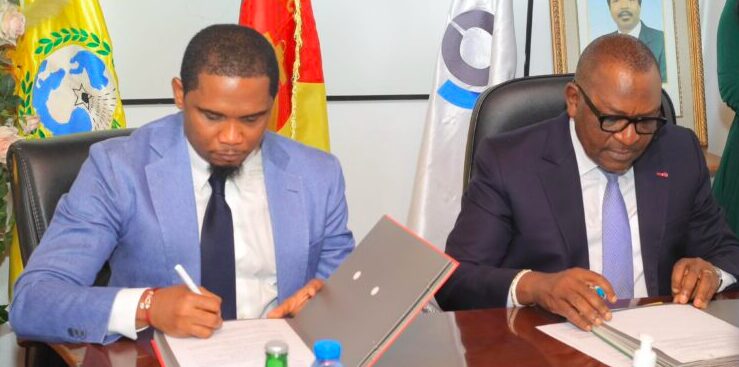
It was against this backdrop that Fécafoot, led by Samuel Eto'o Fils, decided to take action. On 5 April in Yaoundé, a three-year partnership agreement was signed with the General Directorate of Customs, represented by its Director General, Fongod Edwin Nuvaga. The aim: to fight fraud and the smuggling of Indomitable Lions shirts. "We signed this partnership to allow our brothers to do business in a secure environment. Fécafoot has the rights to sell Fourteen shirts, so you can buy your shirts, which would also allow us to pay customs duties and everyone would work in good conditions," Samuel Eto'o said at the signing.
In practical terms, Customs and Fécafoot will now carry out joint inspections and keep a closer watch on the import and distribution of products branded Fourteen, the national team's exclusive supplier. The ambition is twofold: to protect the Federation's exclusive rights over these products and to raise more tax revenue. "We won't need to carry out raids where people get upset. Since they love their national teams, they will all let us live in a peaceful environment where everyone can do their business while respecting the laws of our country," Samuel Eto'o added, in a conciliatory but firm tone.
Read also: Controversy, outburst, resignation threat… the 5 key takeaways from the Indomitable Lions' break
Anger on the street
On the ground, the message is not going down well. Many Cameroonians interviewed say the prices of official shirts are simply out of reach. "I have three children. They all love the Lions. If I have to buy each of them a shirt at 30,000 francs, the bill will hurt. I'd still rather fall back on what comes out of Mokolo, even if it's not the original," says Hilary, a food seller at Mfoundi market, also in Yaoundé.
Amadou, a motorbike taxi driver in Douala, echoes the sentiment: "15,000 FCFA for a shirt? I don't even earn that in two days. I'll keep buying my shirts from the back-back [on the black market, editor's note], at least I can get two for the price of one."
The high cost of counterfeiting
This situation highlights the dilemma Fécafoot has to manage: enforcing its commercial rights while staying in touch with its supporters' economic realities. The proliferation of counterfeit shirts, often passed off as "made in Turkey", means a direct loss of commercial revenue for the Federation. Beyond the lost income, the national team's brand image suffers, all the more so as these copies are sometimes of dubious quality.
While the agreement with Customs shows a firm commitment to professionalisation, it will not be enough without a more inclusive pricing policy or awareness campaigns about authorised points of sale. Otherwise, the parallel market will keep thriving… much to Samuel Eto'o's dismay.