
USM Algiers: The silent revolution of Lamine Ndiaye
When USM Alger entrusted its bench to Lamine Ndiaye in February 2026, the club was primarily looking for a man capable of putting out the fire. Three months later, the Senegalese technician ends the season with an Algerian Cup, a CAF Confederation Cup and the status of strong man of Algerian football. Behind the trophies, it is above all a tactical, mental and structural transformation that the former coach of TP Mazembe imposed on a team that seemed to have lost its balance.
Philemon MBALE · Author profile ·
Listen to this story
Audio version in preparation · read aloud by your browser meanwhile
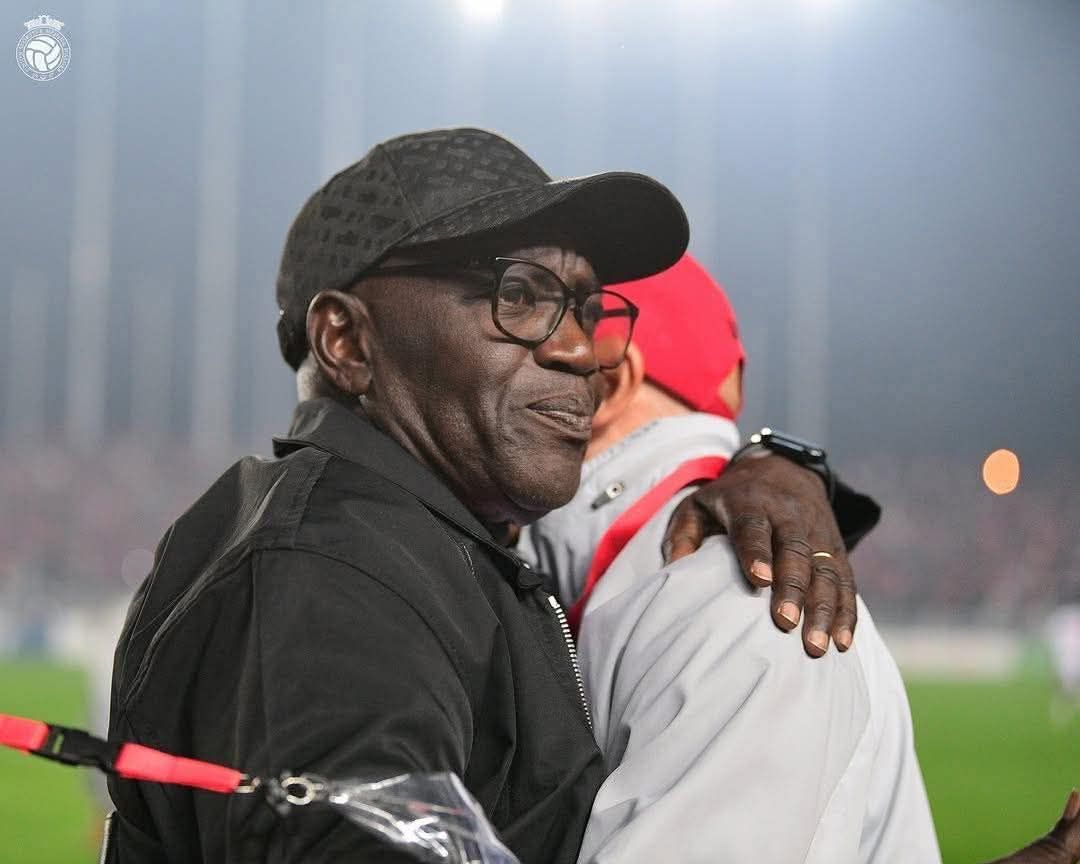
There are coaches who inherit dominant teams. Others arrive in unstable contexts and urgently rebuild. Lamine Ndiaye’s success with USM Alger clearly belongs to the second category. When the Senegalese arrives in February 2026 to replace Abdelhak Benchikha, the Algerian club then experiences a paradoxical season. On the continental scene, USMA impresses. Leader of Group A in the Confederation Cup with 14 points, unbeaten in the group stage, the team has a strong and ambitious face.
But on a domestic level, the setting is much darker: a modest 8th place in the league, an irregular dynamic and a changing room under pressure.
The management then looks for a profile capable of immediately bringing order, experience, and emotional control to major events. Lamine Ndiaye’s choice is not a romantic gamble. It is a choice of skill.
At 69 years old, the Senegalese technician already has a continental reputation built over decades. Winner of the CAF Champions League with TP Mazembe in 2010, past Coton Sport Garoua, Horoya or Al Hilal Omdurman, Ndiaye has long been identified as a specialist in high-tension African competitions. The USMA then offered him a short contract: six months with an option to extend. A clear mission: to stabilize the team and turn its continental potential into a trophy. Three months later, the goal is largely exceeded.
The Ndiaye method: restore calm before winning
The first change made by Lamine Ndiaye was not tactical; it was psychological. In a club filled with doubts, the Senegalese first imposed a culture of serenity. Those who have worked with him regularly mention his calm, discipline and ability to reduce the emotional environment around major matches. At the USMA, this mental management quickly produced visible effects.
The team has become more patient, more mature and above all much more difficult to disorganize. This was especially true during the Confederation Cup’s knockout phase. In the quarter-finals, USMA lost 2-1 on the pitch of Maniema Union in the DRC. Many then imagined a premature elimination. Ndiaye refuses to panic.
In the return, his team won 1-0 in Algiers and qualified thanks to the away goals rule. In the semi-finals against Olympique Club de Safi, the scenario becomes even more revealing of the philosophy of the Senegalese technician. After a 0-0 draw in Algiers, the USMA snatched a 1-1 draw in Morocco in an extremely tactical match. Again, the team does not necessarily shine by the show, but by its mastery of moments. This ability to survive under pressure will reach its peak in the final against Zamalek.
Winner 1-0 in the first leg thanks to a penalty converted in the 98th minute, USMA is immediately put under pressure in the return to Cairo with a penalty taken from the 5th minute by Oday Dabbagh. In an incandescent stadium, facing one of the largest institutions of African football, the people of Algiers suffer but never break. The penalty shootout won 8-7 is not just a technical success. It symbolizes the mental transformation of a team that has become able to resist in the most hostile contexts. In a press conference, Lamine N'Diaye highlighted the work done upstream to manage this type of scenario. He said:
"We have trained well on penalties in different ways and we have already won the Algerian Cup as well as now the Confederation Cup thanks to that. I had a list of the best Zamalek shooters that I kept in my pocket during the match."
A much clearer tactical identity
The other major achievement of Ndiaye concerns the organization of the game. Upon his arrival, the Senegalese coach stabilizes the team around a flexible 4-1-2-3, designed to control the heart of the field and gradually stifle the opponent. The central idea is based on high possession, better occupation of half-spaces and strong collective discipline without a ball.
Defensive work is probably the biggest achievement of this transformation. The combination of Cameroonian Che Malone and Hocine Dehiri quickly became one of the team’s bases. During the final return to Cairo, Che Malone symbolized this strength by winning four aerial duels and completing 61 passes despite the intensity of the Egyptian pressure. In the middle, Ndiaye built a complementary trio around Islam Merili, Brahim Benzaza and the Senegalese Aimé Tendeng.
Merili’s role as sentinel made the transitions safe, while Benzaza brought balance to the traffic. Aimé Tendeng, on the other hand, embodied the vertical energy that Ndiaye wanted. His activity between the lines allowed the USMA to breathe better offensively while maintaining a significant volume at the pressing. Even in a hostile environment in Cairo, the USMA finished with 64% possession, proof of the collective trust established by the Senegalese technician.
Immediately valued recruits
One of Lamine Ndiaye’s great strengths was also his ability to quickly optimize the offensive profiles at his disposal. Ivorian Dramane Kamagaté has become one of the symbols of this dynamic. Used in a more aggressive role and closer to the surface, it brought a constant threat in knockout matches. His impact was also decisive in the victory in the final of the Algerian Cup against CR Belouizdad (2-1). The Senegalese Aimé Tendeng has also reached a milestone in this more structured organization, becoming a central element of the collective balance. This work of individual valorization illustrates another quality of Ndiaye: his ability to simplify roles in order to maximize collective yield.
Pragmatism before the show
Lamine Ndiaye’s success is not based on spectacular football. It is based on an idea that is much rarer in modern African football: mastery. On several occasions, the USMA has agreed to suffer without losing its organization. The Senegalese technician has built a team capable of playing different registers depending on the context: controlling the ball, defending low, breaking the rhythm or surviving mentally. This tactical flexibility largely explains the continental course of the club. In an African competition where displacement, popular pressure, and playing conditions can quickly turn a confrontation on its head, Ndiaye has put experience back at the center of the project. And this experience has spoken in decisive moments.
A coach now in a historical circle
Lamine Ndiaye among the best technicians in the world
With this consecration in the Confederation Cup, Lamine Ndiaye now enters a very restricted category of African football. The Senegalese becomes only the fifth African coach to have won both the CAF Champions League and the Confederation Cup, joining technicians like Faouzi Benzarti, Hocine Ammouta or Moine Chaabani.
Beyond the statistics, this performance above all confirms its place among the continent’s leading tacticians. Because Ndiaye’s feat does not lie solely in the trophies won. It lies in the speed with which he transformed a fragile team into a competitive machine. In the space of three months, USM Alger has gone from doubt to a historic double Algeria Cup – CAF Cup. And behind this metamorphosis, there is the signature of a coach who continues, at 69 years old, to demonstrate that tactical mastery and human management remain the most valuable currencies in modern African football.