
Volleyball: what does the libero in the different jersey actually do?
The jersey makes the libero easy to spot, but the real impact often comes on the first contact with the ball. Reception, defence and back-and-forth play: understanding the libero's role helps you follow a rally before the decisive smash.
Contribution SNA · Author profile ·
Listen to this story
Synthetic English voice · 3 min 03 s
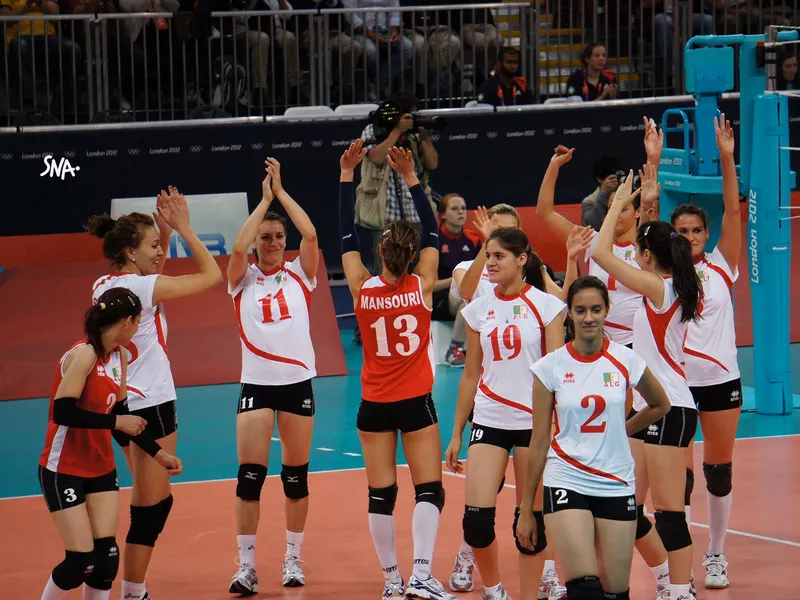
Algeria at London 2012: the liberos in red stand out from the group in white. Archive, cdephotos, CC BY 2.0.
In this photo of Algeria at the London 2012 Games, two red jerseys stand out from the group in white. They belong to the two liberos of the Algerian women's team. A team can name two, but only one can be on court at a time. The colour helps referees to recognise these specialists and to enforce the rules that apply only to them.
From the opposition's serve, the libero is often responsible for receiving the ball with a bump, the forearms together, and then tries to pass it to the setter, who organises the attack. An accurate first touch gives the team more options; a poorly controlled ball can force them to send it back without being able to attack in good conditions.
The point starts before the smash
Take an example: the serve goes deep to the back of the court. The libero controls it and sends the ball to the setter. The setter can then choose which attacker to give the ball to. The libero does not necessarily score the point, but the reception helped set it up. When the opposition attacks, the libero also tries to stop the ball from hitting the floor: that is defence.
Watching only the player who hits above the net therefore means missing part of the rally. Following the different jersey shows how the team recovers the ball and gives itself another chance to attack.
Frequent entries, precise limits
The libero replaces a back-row player. These entries do not count as ordinary substitutions and are not limited in number. As a general rule, however, a completed rally must separate two replacements involving the libero; these take place when the ball is out of play, before the whistle authorising the serve.
The libero can neither serve, nor block — stop the attack at the net — nor attempt a block. The libero can move near the net, but cannot complete an attack if, at the moment of contact, the ball is entirely above the top of the net. Reducing the libero to a player who can never send the ball back to the opposition would therefore be misleading.
Another detail to watch: from the front zone, between the net and the three-metre line, an overhead finger pass by the libero stops a team-mate from finishing an attack on that ball when it is entirely above the net. A bump does not trigger this restriction. The action and the location matter, not just the colour of the jersey.
In the next match, follow one full sequence: the opposition's serve, the libero's reception, then the pass to the attacker. The point no longer tells you only who hit hardest: you also see who made it possible.
Sources
- FIVB — Official Rules 2025 to 2028, Article 19
- Graeme Massie, The Independent — 6 August 2021
- Matthias Kemter, Stuttgarter Zeitung — 27 July 2024
- NBC Olympics — The libero's role
- Olympedia — positions of Algeria's liberos at London 2012
Reference rulebook: FIVB 2025 to 2028, indoor volleyball.
Photograph: cdephotos, Algeria at the London Games, 28 July 2012, Flickr via Wikimedia Commons. CC BY 2.0. Cropped, with SNA logo added; archive photograph, not a reconstruction.
.jpg)