
1997: the Lions of Senegal return to the top of African basketball
In 1997, the Lions of Senegal reached the top of African basketball. The country of Teranga won its fifth title.
Sport News Africa · Author profile ·
Listen to this story
Audio version in preparation · read aloud by your browser meanwhile
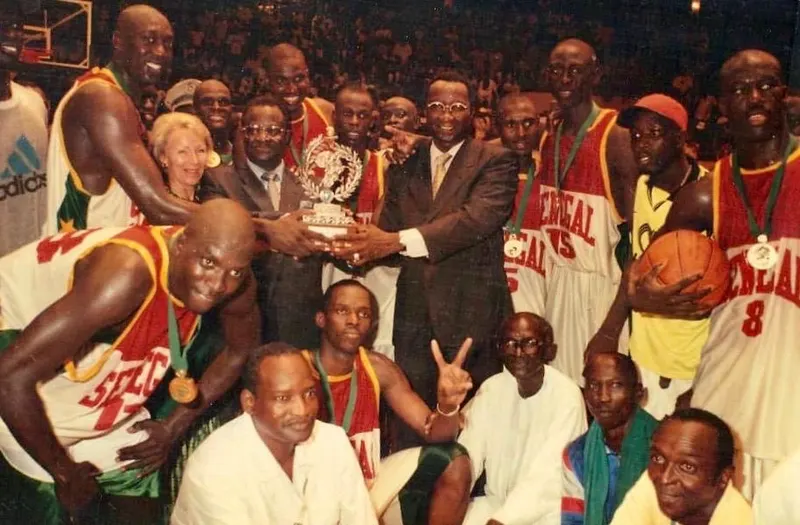
The date of 3 August 1997 still stands firm against the passage of time in the Senegalese basketball family. As the year of the Senegal men's team's last continental title, 1997 has still not been wiped from the record books. Eleven editions later, Aly Ngoné Niang's group remains the last to have stepped onto the top step of the podium at the men's African championships. It is a source of immense pride for the former Lions point guard, who recalls an edition full of twists and turns.
A tight-knit team out to take down the new Angolan powerhouse
Africa's benchmark in men's basketball from 1968 to 1980, with 7 consecutive finals, 4 of them won, Senegal was overtaken in that pecking order over the following 15 years. "Angola had beaten us in the final in 1995 in Algeria and was our main rival, along with Nigeria and Egypt," explains Aly Ngoné Niang, the Lions' point guard in 1997, speaking to Sport News Africa. "They were starting to have a stranglehold on African basketball. Despite the defeat in the final, we knew their team and the Angolan players well. In 1997, we were determined to put an end to their reign because we were at home." In 1997, continuity was the watchword. The staff led by Bassirou Badji and Ousmane Sarr kept the backbone of the 1995 group. Eight of the 12 players had been part of the Algerian adventure two years earlier. "Keeping the backbone of 1995 was essential," says Aly Ngoné Niang. "That team was a family. Even in difficult times, we were all together," he added.
On the same subject: Senegal basketball: diagnosing the repeated failures
A spirit of solidarity was put to a severe test in the group stage. In front of their own supporters, the Lions lost to Nigeria's D-Tigers. It was a bitter defeat. "When we lost to Nigeria, we were furious. After that game, on the bus back to the hotel, the supporters called us every name under the sun. At the hotel, nobody had dinner. The staff did everything they could, but none of us wanted to eat. The defeat was stuck in our throats," says the former Senegal point guard. He continues: "When we met Nigeria again in the final, we told ourselves that this time we weren't going to let it happen. That cup could not slip away from us. We held a meeting before the game to tell each other that this final was the chance of our lives. We had to beat Nigeria. We were fired up. We played as a group, everybody gave everything, body and soul. That is what allowed us to become African champions."
Hosting the tournament to regain the throne 17 years later
To reconquer Africa, the Lions of Senegal got a political boost. The leaders of the Senegalese Basketball Federation (FSBB) decided to bid to host the tournament in Dakar. "We were coming off a defeat in the final of the 1995 Afrobasket in Algeria against Angola. The leaders, led by president Ibou Diagne, then got together to secure the hosting of the 1997 edition in order to regain the throne," recalls Aly Ngoné Niang. A home tournament and a quality group made up of locally based players and expatriates. After a month of tough preparation in Thiès (70 km from Dakar) with some thirty players, the squad was finalized with Aly Ngoné Niang, Oumar Mal, Alassane Ndiaye, Raymond Carvalho, Malick Fall, Vincent Dasylva, Boubacar Aw, Makhtar Ndiaye, Assane Ndiaye, Cheikh Mbacké Diop, Mouhamadou Sow and Cheikh Yaya Dia, ready to go after the 5th continental crown.
Still, the victorious run of 1997 was not smooth sailing. Financial problems crept into the preparation of Aly Ngoné Niang's teammates. "The difficulties we had at the time came when it was time to leave for the United States for a training camp, in difficult conditions. On top of that, the bonuses were insignificant. So we went on strike and refused to board without an increase in the bonuses. It was eventually settled and we left for the United States," revealed Aly Ngoné Niang.
An indescribable bond
Playing in front of your own fans is not always an advantage in sport. Supporters' expectations can sometimes turn into negative pressure. And Senegalese basketball fans are not known for their patience, especially when waiting for an end to a 17-year drought. " The supporters were angry after the loss to Nigeria in the group stage, and they didn't fail to let us know it," recalls Aly Ngoné Niang. "We heard everything that night after the game. But we weren't downcast on our side. We knew it was just a hiccup that didn't call into question any of our objectives," said the man who is now head coach of the men's team of AS Ville de Dakar (D1).
A demanding crowd, yes, but one of the best crowds in Africa played a decisive role in this reconquest. "The atmosphere was exceptional on the day of the final," says Aly Ngoné. "When we left the hotel, it was impossible to get into the Marius Ndiaye stadium, which was already packed to the rafters. There were still thousands of people outside who wanted to get in. We were overwhelmed when we saw that. We asked ourselves how we could possibly let all these people down," recalls the former Senegal playmaker. Crowds outside the Marius Ndiaye stadium, and a sense of togetherness inside the arena for the lucky ones who got in. "Inside the stadium it was frenzy, with chants of 'Senegal, Senegal' coming down from the stands. We had goosebumps. The game was settled in the first half. We had a lead of some twenty points in the first half. It was a source of immense pride because Senegal had gone 17 long years without a title. Our generation was able to put right that anomaly. The country's 5th title," he said proudly, his voice filled with emotion.
Seventeen years of waiting for a much-coveted 5th continental star. The heroes of 1997 were able to gauge the extent of their new fame among the people. "After the final, basketball was on everyone's lips in Senegal. We were adored by the people. President Abdou Diouf received us at the Palace and rewarded us. It was boundless joy for us. It was grand. Winning the African Cup for your country, and at home in front of your family, after 17 years of waiting. There is nothing greater, it was exceptional," recalled Aly Ngoné Niang.
Moustapha M. SADIO