
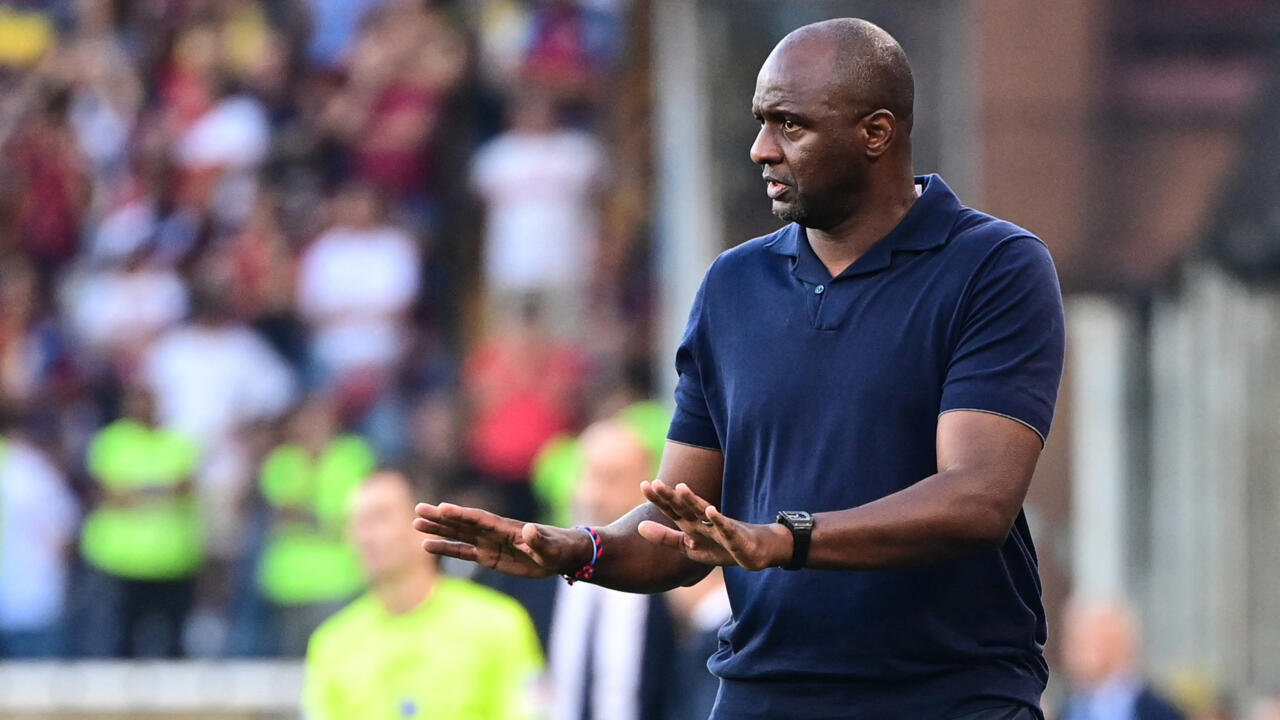
Patrick Vieira was certainly expecting something different for his first official appearance with Senegal. But for his baptism of fire, the Franco-Senegalese coach was thrown straight into a particularly demanding situation. A trip to Maputo, a difficult pitch, a compact opponent, and a squad deprived of several of its key players. All the ingredients were there to turn this first outing into a real test.
Yet Senegal started the match on the right foot. On a challenging pitch at the Zimpeto National Stadium, the Lions showed good intentions in the first half and gradually took control of the play. The reward came in the 32nd minute with Nicolas Jackson, set up by Abdallah Sima. But just as Senegal seemed likely to head to the locker room with this advantage, Geny Catamo put both teams back on level terms in the additional time of the first half, with a powerful shot from outside the box.
The second half then revealed Senegal’s limitations. Vieira’s men maintained a significant share of possession but were unable to truly break down a well-organized Mozambican block. The game became more fragmented and attacking options became increasingly scarce. The coach tried to bring in fresh legs, notably with the introduction of Idrissa Gana Guèye, but the Lions never regained the fluidity they had shown in the first half.
A debut that serves as a reminder of the continent’s realities
For Vieira, this match also held special meaning. A former top-level player in Europe, he was taking charge in Maputo for his first game as the coach of a national team and, above all, his first official match on the African continent in this role. The context was therefore new to him. And he immediately discovered one of the defining features of African competitions: an away match is not just about the difference in level between two squads.
Senegal was originally supposed to host Mozambique in Dakar. The match was eventually moved to Maputo because the Abdoulaye Wade Stadium was unavailable due to its use for the Youth Olympic Games, and the pitch at Léopold Sédar Senghor Stadium was in poor condition. As a result, Senegal found themselves playing away a match that was meant to be at home. On top of that, the difficult pitch did not favor teams trying to play quick and precise football.
In such contexts, technical mastery is not always enough. One must also know how to manage the tempo, the duels, the weak moments, and the pressure from a home crowd. Mozambique made full use of these circumstances to secure a point.
Vieira, for his part, acknowledged his team's shortcomings without making excuses. “There are obviously regrets. I think we deserved better in the first half,” he said after the match. The coach also felt that this first outing helped identify the areas in need of improvement. “We’ve identified the shortcomings and we’ll address them with hard work,” he assured.
A Senegal still missing several key references
This first appearance must also be seen in context. Vieira did not have all the trademark references of Senegal in recent years. Edouard Mendy has retired from the international stage with the Lions. In Maputo, it was Yehvann Diouf who started in goal, bearing the heavy responsibility of succeeding the former Chelsea goalkeeper.
Another strong choice from the new coach: Kalidou Koulibaly started on the bench, while Idrissa Gana Guèye only came on in the second half. Moussa Niakhaté therefore wore the captain’s armband. Sadio Mané, another major figure of the squad, was absent due to a physical issue. These absences and decisions also demonstrate Vieira’s desire to begin establishing his own reference points. The new coach now has to build a team capable of maintaining its level of performance while gradually integrating a new generation.
The first match, moreover, offered some encouraging signs. Senegal showed intensity and good intentions before the break, with interesting combinations between Abdallah Sima and Nicolas Jackson. But the team lost control after Mozambique’s equalizer. The problem is, therefore, not just about offensive efficiency. It also concerns the ability to manage the different phases of a match and to find solutions when the game scenario becomes less favorable. Vieira is aware of this.
“It was important to lay the foundations,” he explained after the match, while stating that his team was “on the right path” in terms of attitude and commitment. For Senegal, this first point is by no means a disastrous result, but nor is it the start they had hoped for. The African champions will have to quickly raise their level of control, as the calendar leaves the new coach little time to implement his project. On Tuesday, the Lions will be away again, this time in Ethiopia, for their second qualifying match.
Two away games to start off, two different contexts, but the same requirement: to learn quickly how to win in environments where Senegal’s status alone is not enough. For Vieira, the real work starts now.
Join our sports community!
Follow us on social media to never miss real-time sports news.
À propos de l'auteur

El Hadji Malick SARR
Rédacteur sportif
Passionné de sport depuis toujours, partage avec vous les dernières actualités et analyses du monde sportif.