

At 23 years old, Saly Sarr continues to shake up the codes of the world of sports. A world where the best prepared athletes are almost always ranked highest in international competitions. The 2024 African champion is far from receiving as much consideration from her country’s sports authorities. Nor in its preparation, let alone in the daily support for a high-level athlete. Nothing to prevent him from overcoming obstacles in a discipline requiring calibrated preparation over an entire year.
“Today her competitors look at her differently”
This summer in the Japanese capital, Saly set himself a challenge: to beat his personal record. She does better than that by putting a slap on what was hitherto her reference brand, 14m41 established in July 2025. The protégé of former Senegalese high jumper Manirou Dembélé sets a new personal record at 14m55 in a world final.
Proof if any more needed that she ignores the stress. She fails at 1 small cm from the reigning Olympic vice-champion, Shanieka Ricketts, 5th (14m56) and at 21 cm from the legend and recordwoman of the triple jump, the Venezuelan Yulimar Rojas. With her jump at 14m76, the Olympic champion in 2021 nevertheless achieved her best performance of the year 2025.
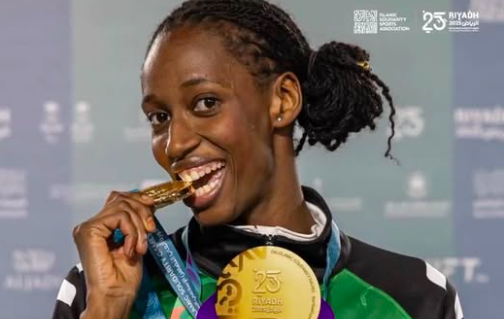
Saly Sarr forced his way through at the cost of many hours of sacrifices to gently but surely nibble on what is best in the ladies' triple jump. This exploit on Japanese soil opens new perspectives for him.
"This 6th place at the last world championships in Tokyo changes a lot of things in his young career, supports his manager. Today, her competitors look at her differently. Now she is expected at every outing she makes,"
said Manirou Dembélé.
"At our level, it makes things easier for us, we can place her in big meetings, we can negotiate more things for her and some sponsors revolve around Saly."
But it’s not just that has changed for Saly.
“At the management level, it makes a lot of things easier for us with the biggest meetings, the Diamond League, series A meetings, which like to have top world athletes. Saly is now part of this circle of internationally renowned athletes. At our level, it makes things easier for us, we can place her in big meetings, we can negotiate more things for her and some sponsors revolve around Saly. In not long we will sign an agreement with a supplier, the negotiations are progressing well. All this helps him well, it also helps the staff because it’s very difficult financially. It will at least allow us to manage a small part of his preparation for the upcoming championships,"
revealed the five-time high jump champion of Senegal.
Handicapped by the lethargy of Senegalese leaders
Despite this new dimension, Saly Sarr and his team are still confronted with the unchanging immobility of the sports authorities.
“Those who govern sport here at home, the Ministry of Sports and the Olympic Committee had to struggle to coordinate in order to allow the athlete to go further. It has always been like that. I am in the field of athletics, I have been an athlete. I saw quite a few athletes pass by, really talented athletes, maybe more talented than Saly. In the end, it didn’t give anything because he was missing this little thing,"
denounces Dembélé.
Who adds with a touch of irony: «The Athletics Federation, the CNOSS and the Ministry of Sports must work together around the Saly Sarr project. For the moment it is not done. I fear that it will happen as usual a month before the Los Angeles 2028 Olympics.”
For him, we must not reinvent the wheel, that the three entities must accompany the career plan of their elite athlete to allow him to have all his chances in 2028. It’s not complicated, the athlete has a project with a training plan for the whole year, with his coach, his physiotherapist, his osteopath. In addition to three annual courses for winter, spring and summer training to prepare for the major championships. It is the athlete and their coach who decide according to the weather conditions, the training conditions and the available tracks," he explains.
He warns that this is the only way to find a successor to Elhadj Amadou Dia Ba, until now the only medalist in Senegal’s history at the Olympics.
"If we want to win a new Olympic medal for Senegal, whether it’s Saly or the others, the leaders must get around the table and decide who does what. Today we are left to our own devices. It’s up to me, his agent, to find a coach in Saly, to find him an internship place, to negotiate and find him meetings. Managing an athlete of her size requires a lot of time and support. Managing an athlete an athlete is not the same as managing a footballer or a basketball player. We are behind the athlete 24 hours a day on administrative, logistical, and organizational needs. If we want to succeed, all these actors must agree on the roles. We have the financial part, the Federation has Saly’s schedule and program. We, his staff, are in charge of coordinating this program. It’s simple but it’s that we have difficulty doing in Senegal.
Having in its ranks a world 6th in athletics should be accompanied by a vision and synergy of actions aimed at putting the elite athlete in the best performance conditions. The inertia of the Senegalese sports authorities has in the past led the hurdler Mamadou Kassé Hann to change his sporting nationality in favor of France. Is Senegal at risk of reliving such a catastrophic scenario with Saly Sarr?
Join our sports community!
Follow us on social media to never miss real-time sports news.
Tags
À propos de l'auteur

Moustapha SADIO
Rédacteur sportif
Passionné de sport depuis toujours, partage avec vous les dernières actualités et analyses du monde sportif.