
Carine Ayom: "The difficulties of refereeing a men's match"
Carine Ayom is delighted by the progress of women's refereeing in world football, notably the presence of women officials at the World Cup
Sport News Africa · Author profile ·
Listen to this story
Audio version in preparation · read aloud by your browser meanwhile
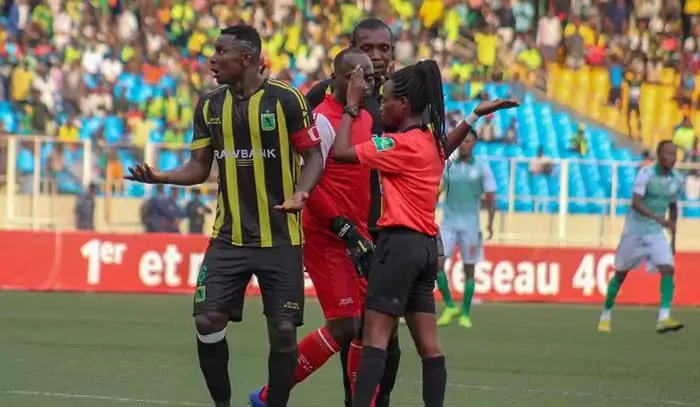
Carine Ayom, for the first time in history, female referees are present at a men's World Cup. How does it feel to see that?
Carine Ayom: I'm very happy, it's a real source of motivation for me. It proves that women's refereeing has come a long way. Our work is valued by FIFA and I'm delighted.
Among the first three women pioneers, there is an African, the Rwandan Salima Mukasanga, who was already the first woman to officiate at a men's AFCON. Does having an African among the three give you even more hope for the future?
Carine Ayom: Yes, a lot of hope. When I saw her for the first time at this World Cup as fourth official, I told myself that I too can reach that level, with God's help and a lot of hard work. My goal is to officiate at major men's international competitions like Salima. She is a good example for all African women referees. I would like to officiate at the World Cup one day too.
"Salima Mukasanga gave me advice"
Have you ever met Salima Mukasanga?
Yes, I met her in Cameroon during the last AFCON. I was there to referee the play-off match in the qualifiers for the 2022 Women's U20 World Cup between Cameroon and Nigeria.
Were you able to talk?
Yes, we were able to talk because we were staying in the same hotel. She told me that it's not rocket science to reach her level. You just need discipline and to love your job, nothing more. I took her advice on board and I'm going to work very hard to reach her level, I believe in it.
You are very highly regarded in the DRC, to the point of being appointed to take charge of big Kinshasa derbies between DCMP and V.Club. How do you feel when you referee fixtures like that?
When I referee a men's match, I forget that I'm a woman. When men see a woman with the whistle in their match, they tend to try to intimidate her, but when I step onto the pitch, I see myself as the person in charge on the pitch and I don't let myself be intimidated. That helps me keep control of all of them.
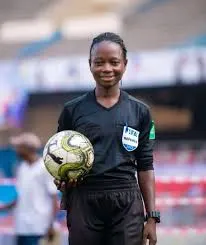 Image recovered from a public archive captured on 04/12/2022. The archived file is verified; the current source is unavailable. View archived capture
You have now earned respect among players and officials. What does that mean to you?
It's a source of pride for me, and it's actually thanks to that that I tell myself that one day I can reach Salima Mukasanga's level. Just refereeing a big derby between DCMP and V.Club is something huge for me, because it takes a very strong mentality, since you see all the country's football stars, and you need steady nerves to keep control of all of them. When I referee a men's derby, I see myself as Stéphanie Frappart, the Frenchwoman who is also at the World Cup. She has established herself in French Ligue 1 and I'm also determined to keep establishing myself in the Congolese Ligue 1.
What did you do to gain credibility?
I imposed personal discipline on myself so as not to let the men manipulate me.
Is refereeing hard for women, especially when you have to officiate a men's match?
Frankly, it's not easy for a woman to be a referee. Several things can happen to you on and off the pitch and, if you don't have steady nerves, you risk giving up. But we hang in there, I know what I want and I keep going.
What are the difficulties you face as a woman referee?
In a male-dominated environment, it's complicated when you're a woman. First, there's the matter of match appointments. Men are favoured because there isn't much trust in women. So it's a kind of discrimination that women referees suffer, especially for derbies, but there has been some improvement, because I, for example, have already been appointed to take charge of the big Kinshasa derbies.
What drove you to take up a career as a referee?
It's a passion for me. At university I studied sports science, and that helped me become a referee. I have been a referee since 2016 and an international referee since 2018.
Carine Ayom, what is the biggest match you have refereed at continental level?
It's the Cameroon v Nigeria match, the play-off in the qualifiers for the 2022 Women's U20 World Cup, a very high-intensity match, and I'm determined to go further.
Jonathan MASIALA