
FECOFA: accusation of serious fraud and interference by FIFA in the electoral process
In a tense political context, the electoral process of the Congolese Football Federation (FECOFA) is now facing serious charges of fraud which would have justified a change to the statutes supposedly carried out in January 2025 but formalized on April 28, 2026, after the deadline for submitting applications. All to promote the election of Véron Mosengo-Omba.
Philemon MBALE · Author profile ·
Listen to this story
Audio version in preparation · read aloud by your browser meanwhile
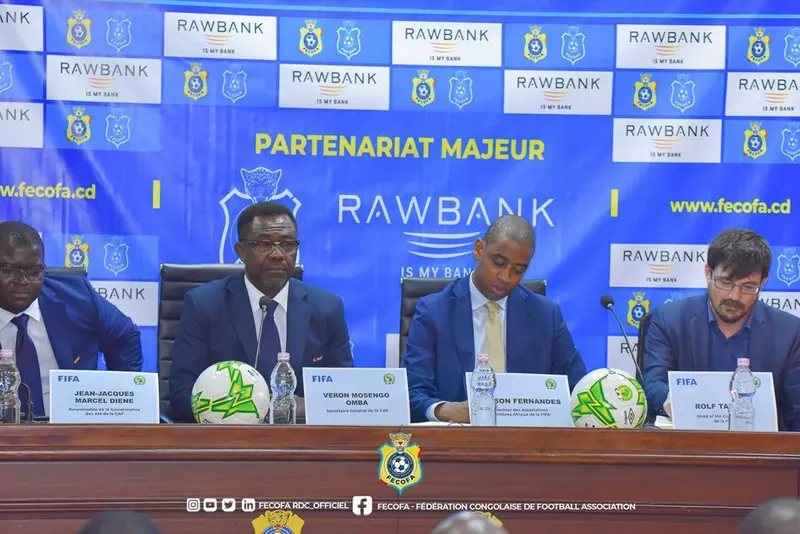
Rarely has an election of an African federation caused so much talk. Of the nine candidates initially interested in the presidency of FECOFA, only the candidacy of Véron Mosengo-Omba was finally validated by the electoral commission of the Congolese football association.
Between the invalidity of several files and the sudden withdrawal for "personal reasons" of the two other lists validated in first instance (Bosco Mwehu and Jean-Didier Massamba), the path was completely marked out to allow Gianni Infantino’s friend, Mosengo-Omba, to be elected on 20 May. Problem, this plebiscite initiated by FIFA and supported by the Congolese presidency seems to attach multiple frauds and even a false document that precisely allowed the validity of the candidacy of the former secretary general of the CAF.
The General Assembly of January 11, 2025, never ratified the change in the statutes.
On January 11, 2025, the Standardization Committee heading FECOFA convened an Extraordinary General Assembly to change certain statutes, notably Article 37 regarding eligibility criteria. The idea was to promote an amendment that would allow an individual who had simply held a position in football (so not necessarily Congolese) to be able to run for office. A text that seems tailor-made for Véron Mosengo-Omba, who had never held any position in Congolese football.
In fact, at the end of an interminable three-and-a-half-year Normalization Committee that ended curiously when he left CAF because he had reached the age limit, he announced his candidacy supported by Gianni Infantino and since then by the Congolese government, notably the Minister of Sports, Didier Budimbu, who summoned the various presidents of the League to his private office on the Avenue de la Justice in order to magnify the candidacy of his new "friend".
Problem, the validity of Véron Mosengo-Omba’s file is based on a change in status. However, it never took place officially since the members of the General Assembly refused the proposals arguing that "an electoral process was underway, no statutory provision should be revised".
The request to change the statutes was rejected during the EGM.
These words, written by three leaders of the regional League (Eidé Vakatsuraki Vayikerye, president of the Provincial League of North Kivu, Georges Magambo Budundwa, president of the Provincial League of South Kivu and Mulowe Rubi Toto, first vice-president of the Eastern Province) in an official correspondence dated April 28 refuted the version put forward by FECOFA, explaining that "the statutes have never been amended since their adoption in 2022."
Fake minutes sent by FIFA
On April 26, five days after the date of submission of candidates, the president of the Electoral Commission, Michy Enyeka Bowangalawanga, wrote to the general secretary of FECOFA to ask her to forward "officially, a copy of the minutes of the Extraordinary General Assembly of January 11, 2025, even though the statutes of the Congolese Football Association Federation were amended."
Curiously, the document had not been sent by the FECOFA administration but by Ahmed Harraz, one of FIFA’s governance officers, who had sent the correspondence two days earlier. Enough to question the supposed independence of the federation.
It is deeply worrying that a document under the exclusive authority of FECOFA was communicated by an external body three days after the closing date for the submission of candidatures for the FECOFA executive committee. This process constitutes a clear interference in the electoral process of our Federation and is characterized by fraud," write the three leaders of the League in their official letter sent to the president of the Electoral Commission and FIFA.
Worse still, how can FIFA send a document that never existed? According to other members present at the Extraordinary General Assembly on January 11, 2025, there was never a report approving the change in the statutes. Therefore, which document could it be?
According to our information, the members of the Normalization Committee at the time, whose appointment gave rise to alerts regarding their connections with Véron Mosengo-Omba, authenticated the new statutes using a notarial deed. A maneuver that does not comply with the statutes of the FECOFA, which require the approval of the members of the General Assembly.
The changes to the statutes appeared in the official journal on April 28, 2026.
If the electoral process begun in 2025 has failed, that of 2026 seems to have succeeded. Curiously, the FECOFA has just waited for this one and more than a year and three months to authenticate the change in its statutes which was published in the official journal on April 28, 2026, that is, one week after the date of submission of applications.
Denounced by Patrice Mangenda, the former deputy secretary general of the FECOFA having put himself forward as a candidate, he recalls in an official correspondence to the Electoral Commission and FIFA article 7 of the electoral code of the FECOFA and article 19 of the statutes of FIFA:
"The electoral rules may not be modified after the publication of the call for candidates, except in cases of force majeure validated by FIFA."
Since the call for applications dated April 5, 2026, and the official change on April 28, 2026, the violation is clearly visible. Enough to question FIFA’s real motivations for remaining silent in a process that does not respect any rules, not even its own, which could create a precedent in the future for other federations or States wishing to push their candidate without taking into account the statutes of the International Federation of Association Football.