
Football: Refereeing in Burkina Faso in search of recognition and improvement
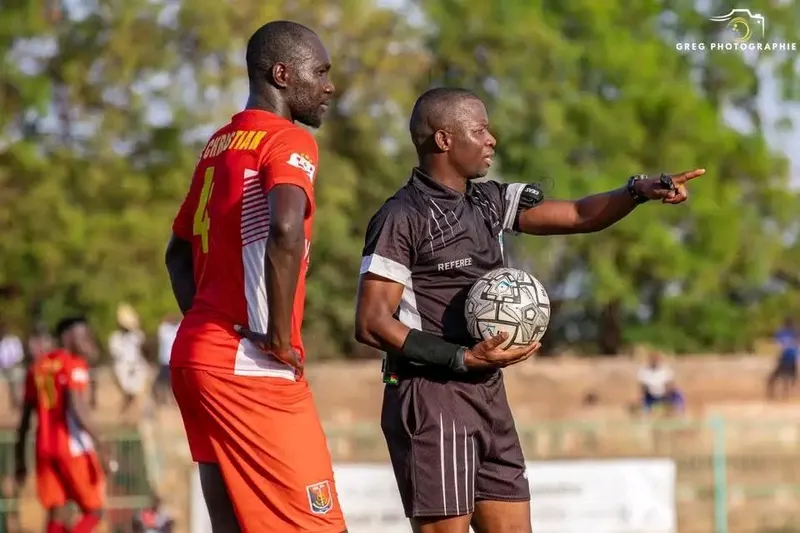
Burkina Faso football, a national passion in the country of honest men, continues to spark lively debates. Among the recurring topics, arbitration occupies a prominent place. Where does it stand today? Is the level high, medium or low? Judging by the reactions of the sporting public and recent events, the picture is nuanced. Notable progress on the international stage contrasts with persistent criticism at the local level. Sport News Africa (SNA) explores the current state of Burkina Faso’s refereeing, drawing on expert and fan opinions as well as recent developments.
Philemon MBALE · Author profile ·
Listen to this story
Audio version in preparation · read aloud by your browser meanwhile
A level perceived as average by the public
The voices of the Burkinabè sports public paint a critical portrait of national refereeing. Adama Sawadogo points out a "low level", attributable to insufficient training and miserable wages. For him, these factors explain the recurring errors and the lack of motivation of the referees.
Ousmane Obiang, on his part, describes the refereeing as 'average', just like the national championship. It highlights the lack of resources made available to referees, comparing their difficulties to those of players with unpaid bonuses and low salaries that make the headlines. "The referees are the forgotten ones of Burkina Faso’s elite football," he insists, stressing that precarious conditions can influence decisions on the field, inadvertently turning a corner into a penalty.
Jacques Djiguemde adopts a balanced position: "Certainly, we’re not going to throw out the baby and the bathwater because there are some good referees anyway, but overall it’s really cheap. There is a lot of work and training to be done.” Justin Badou links the level of refereeing to that of football in Burkina Faso in general: "The referee is at the level of the football game and what we do for our referees." Finally, Ali Diasso advocates for increased valorization: "We must have a policy of valuing our arbitral body. Don’t underestimate us, by the way that referees from other countries are better. Let’s promote our referees to allow this corp to participate in championships on the African level.
These reactions reflect a consensus on Burkinabe arbitration which suffers from a lack of resources and recognition, which impacts its perceived quality. Supporters often deplore mistakes that penalize the teams, such as in local matches where refereeing is accused of being 'scandalous' or 'imaginary'.
Encouraging international progress
Despite these local criticisms, Burkinabe refereeing shows signs of vitality on the continental scene. In 2025, FIFA asked several Burkinabe referees to officiate during the 2026 World Cup qualifiers. For example, eight referees, including Jean Ouattara (central), Lamien Dofinté Adolphe (assistant) and Benoît Bado (fourth official), were called for international matches. A 100% Burkinabè quartet even umpired the match between Sudan and South Sudan in March 2025.
The FIFA 2026 list includes names like Benoit Bado, Hamidou Diero and Awa Alphonsine Ornella Ilboudo (female referee), demonstrating international recognition. Drissa Traoré, former international referee, even goes so far as to assert that "the refereeing of Burkinabe football is ahead of Burkinabe football". Training courses, such as the one for federal arbitrators in the Western Zone, held from January 9 to 11, 2026, indicate efforts to improve skills.
However, even at the international level, controversies persist. Bertrand Traoré, captain of the Stallions, criticized the refereeing during the match against Algeria, denouncing unverified penalties and accusing the referees of 'fucking the game'. These remarks earned him a penalty of 10,000 dollars by the CAF during the 2025 AFCON in Morocco.
A real potential for growth
On a qualitative scale, Burkinabe arbitration can be described as a means. Locally, it is hampered by low wages, a lack of infrastructure and sporadic training. This leads to recurring mistakes, fueling the anger of supporters. However, Burkina Faso produces competent arbitrators, capable of officiating at a high level, which suggests untapped potential.
To raise the level, reforms are needed: wage increases, regular training focused on theory and practice, stricter penalties for repeat offenders as suggested by Obiang, and better integration of technologies such as VAR. The Burkina Faso Football Federation (FBF) could be inspired by the objectives set for the national team, aiming at the top 10 in Africa, to apply a similar ambition to refereeing.
Burkina Faso’s refereeing is neither at the top nor at the bottom of the abyss. It reflects the challenges of national football as a whole. With a policy of valorization, as advocated by Ali Diasso, it could not only improve locally but also shine more on the African scene. The referees, deserve to be at the center of priorities so that the beautiful game triumphs.