
Morocco: Why Walid Regragui should lead at the 2026 World Cup
Under contract with the Royal Moroccan Football Federation until the 2026 World Cup, Walid Regragui is today confirmed in his duties despite the lost final of the AFCON 2025. But beyond this contractual continuity, many arguments tilts for him to be the man at the World Cup.
Arthur WANDJI · Author profile ·
Listen to this story
Audio version in preparation · read aloud by your browser meanwhile
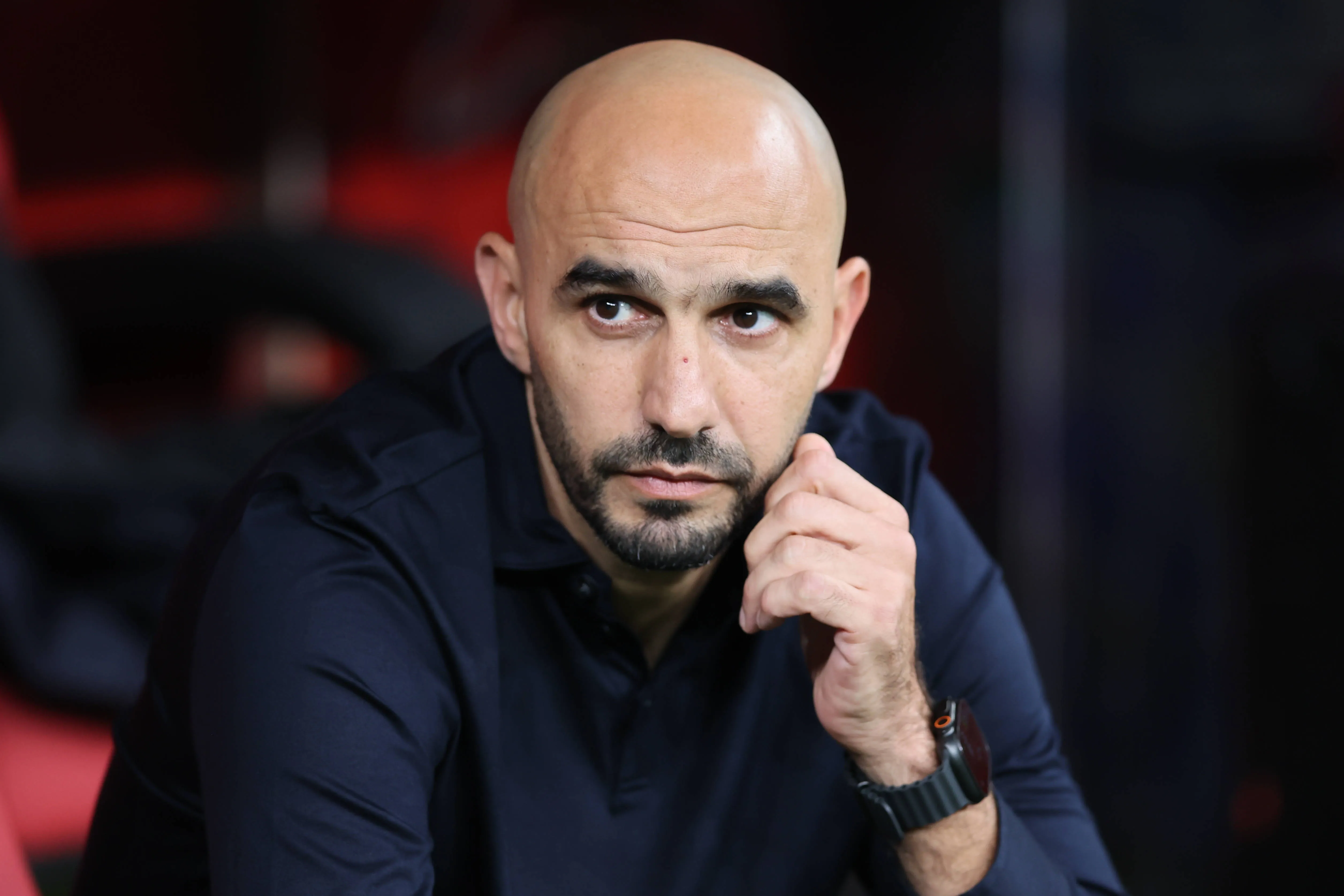
The question of the future of Walid Regragui arose at the wrong time, in the immediate wake of a defeat in the final of the AFCON 2025. However, the trend is clear, the Moroccan coach is still in place and his contract runs until the 2026 World Cup. There remains a question more essential than simple administrative logic: should Regragui, sportively, lead Morocco to this world appointment? On analysis, the response is clearly in favour of yes.
A global status that commits continuity
Since his arrival in 2022, Regragui has profoundly changed the status of Morocco. Semi-finalist of the World Cup in Qatar, the Moroccan team went from being an ambitious underdog to becoming a credible reference on the international stage. This symbolic and sporting capital is directly linked to a man, to a method and to a modern interpretation of football. Breaking this cycle a few months before the World Cup would be tantamount to undermining a rare achievement for an African nation: lasting recognition at the highest level.
A structural progression, not a flash in the skies
The trajectory of Morocco under Regragui is part of the long term. Despite the AFCON 2023 accident (elimination in the round of 16), the coach demonstrated his ability to correct, adjust, and strengthen his project. Improved results, collective soundness, successful integration of new profiles and assumed leadership at key moments. The indicators all point towards a stabilized selection. The progression in the FIFA ranking and the regularity of performances confirm that Morocco no longer depends on an isolated achievement, but on a solid competitive base.
AFCON 2025: A lost final that validates a project
Being the host country, assuming the status of favorite and reaching the final without losing any match in normal time is nothing trivial. The CAN 2025 especially highlighted the tactical maturity of Regragui, able to adjust his game plans, to evolve his eleven type and to maintain a high level of requirement throughout the tournament.
The defeat in the final, as frustrating as it may be, is more a matter of detail than a global challenge. It even confirms that Morocco is now obliged to be judged on the final victory, a luxury that few African selections can afford.
The World Cup as the logical outcome of the cycle
Between the AFCON 2025 and the 2026 World Cup, time is short. In this context, stability is not a default choice, but a strategic weapon. Regragui knows his group perfectly well, his leaders, his internal balances and the requirements of the very high level. Changing the coach at this stage would mean embarking on a costly adaptation phase, even though Morocco already has automatic procedures, a clear identity and an assumed ambition.
A coach who progresses with his team
Finally, Walid Regragui is not a fixed project. Through the great competitions, he himself has grown in his position. Each tournament has enriched his reading of the game, management of pressure and relationship to popular demand. This parallel evolution of the coach and his group is a strong argument in favor of continuity until the World Cup.
Yes, the current trend is to maintain Walid Regragui, because his contract runs until the 2026 World Cup. But above all, Morocco would have everything to lose by breaking such a structured cycle at the dawn of a historic rendezvous. By his results, vision and ability to place the selection at the very high global level, Regragui must not only remain. He must lead the Atlas Lions to the World Cup.