
'Partnership of shame': PSG accused of complicity with Rwanda
'Partnership of shame': PSG accused of complicity with Rwanda after renewing its sponsorship deal
Sport News Africa · Author profile ·
Listen to this story
Audio version in preparation · read aloud by your browser meanwhile
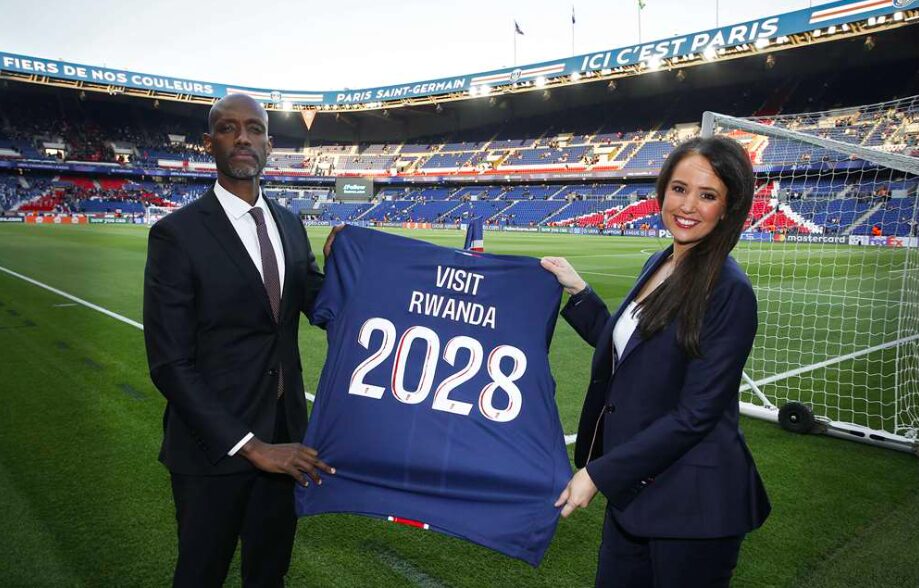
When economic interests collide with ethical responsibilities... Paris Saint-Germain announced this April that its partnership with Rwanda has been renewed until 2028 as part of the "Visit Rwanda" campaign. The deal, with considerable commercial and tourism reach, has been hailed by both parties for its "transformative dimension". But the agreement, signed against a backdrop of security crisis in the Democratic Republic of Congo, is drawing a growing wave of criticism and condemnation. As the conflict in eastern DRC intensifies, the cooperation between the Paris club and the Kigali regime is becoming harder and harder to justify in the eyes of many observers.
A lucrative but controversial deal
Since 2019, Rwanda has been one of PSG's major sponsors. The "Visit Rwanda" logo appears on the sleeve of the first team's shirt, as well as on the training kit of the Paris side, and on that of the club's academies in the United States and Canada. In a statement, the Rwanda Development Board (RDB), the body responsible for the country's economic promotion, welcomed the renewal: "Since the start of the partnership, millions of fans around the world have discovered Rwanda thanks to the television exposure provided by PSG. "
The capital club placed more emphasis on the international reach of the collaboration, which is expected to extend to the upcoming 2025 Club World Cup in the United States, where the Visit Rwanda logo will again be prominently displayed. But behind this carefully honed communications messaging, the geopolitical reality is far more complex.
An explosive geopolitical context
Rwanda is accused by the United Nations, NGOs and several Western governments of actively supporting the armed group M23, which is fighting Congolese forces in eastern DRC. According to UN experts, this support comes with the presence of several thousand Rwandan soldiers on Congolese soil. For several months, M23 has seized large areas of territory in North Kivu and South Kivu provinces, causing thousands of deaths, abuses, mass displacement of people and a major humanitarian crisis.
Read also: DR Congo calls on Formula 1 over Rwanda
In response, several countries, including the United States and France, have recently imposed targeted sanctions on Kigali. International pressure is growing, but calls for M23 and Rwandan forces to withdraw remain unheeded.
A tarnished image for PSG
Against this backdrop, PSG's decision to extend its partnership with Rwanda has gone down badly. On social media, reactions are sharp: many internet users, particularly in French-speaking Africa, are denouncing what they regard as a "partnership of shame". An online petition has gathered no fewer than 75,000 signatures, accusing the Paris club of playing into the hands of a regime involved in a bloody conflict.
"PSG cannot ignore what is happening in the DRC. By accepting money from Rwanda, the club is indirectly condoning serious abuses," says a Congolese activist involved in the campaign. Several Congolese diaspora associations are also calling for protests outside the Parc des Princes.
The Paris club, for its part, has not responded to the criticism. Its silence is fuelling the anger of its detractors, who see it as contempt for the victims of the conflict and as putting "the football business industry" ahead of human lives.
A contested soft power exercise
Rwanda's strategy, described as "sportswashing" by some analysts, rests on heavy investment in prestigious clubs to polish its international image. As well as PSG, Visit Rwanda is also a partner of Arsenal in the Premier League and Bayern Munich in the Bundesliga. Through tens of millions of euros in spending, Kigali is seeking to position itself as a major tourist destination, while cultivating a narrative of modernity and stability.
But this charm offensive now runs up against the reality of a devastating regional conflict. Within European political circles, voices are starting to question whether the values sports clubs defend are compatible with the alliances they forge with certain states.
A growing unease
The renewal of the contract between PSG and Visit Rwanda comes at a time when criticism of Kigali is at its highest level. For many, the partnership tarnishes the Paris club's image and raises major ethical questions: can a club keep promoting a state accused of crimes against civilians? And how far can marketing logic be allowed to outweigh moral responsibilities in the world of sport?
With no official response from PSG, the controversy is unlikely to die down any time soon. On the contrary, it risks becoming a lasting fixture in the club's news cycle, as football comes under ever closer scrutiny for its links with authoritarian regimes.