
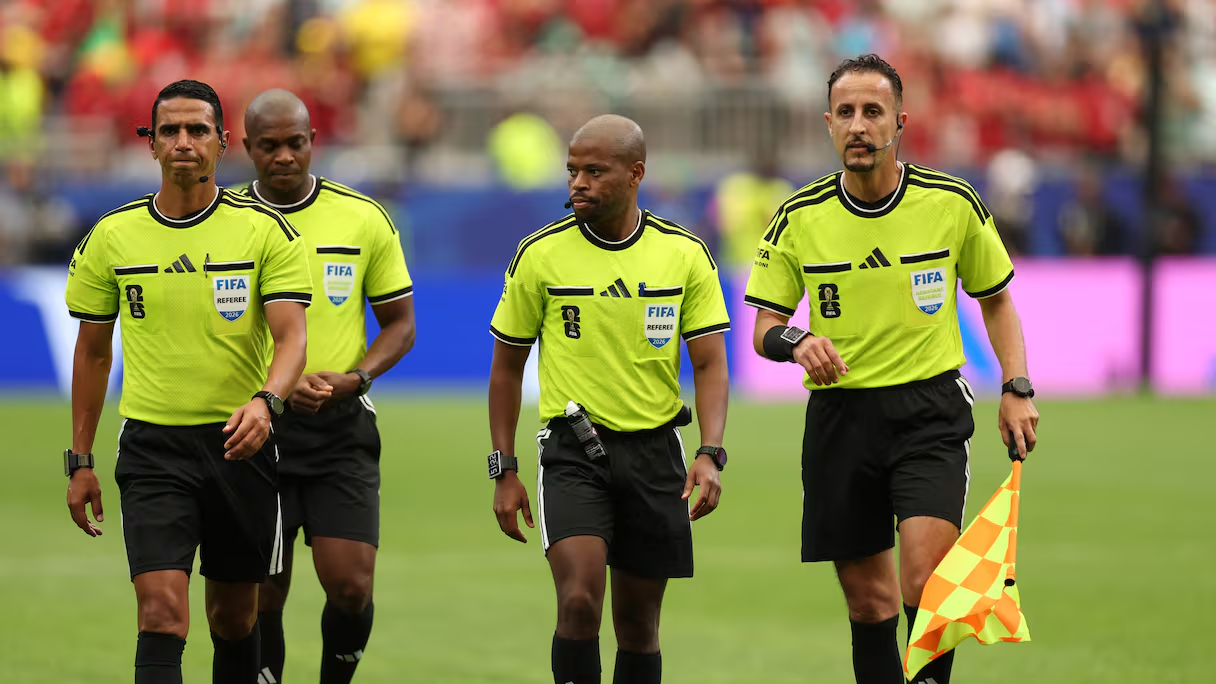
While the football world has its eyes fixed on the outcome of this first 48-team World Cup with the final to be held on July 19, a bitter observation is clear for African football. On the field, national teams have been both hot and cold—with Morocco once again carrying the continent's flag as far as the quarterfinals—but behind the scenes and on the pitches, the trajectory of African referees came to an abrupt halt.
An early exit, from the round of 32, raises questions: is it simply a technical glass ceiling, or is the African whistle a collateral victim of geopolitical tensions beyond its control?
Departure under tension and a meager accounting record
Even before the first whistle was blown on North American soil, the tone had been set. The ban on entry to the US territory served to Somali referee Omar Abdulkadir Artan acted as an early warning sign. Deprived of the tournament for administrative reasons and left to his fate with no support from FIFA, he left the African delegation short one of its promising faces.
Of the 19 African officials selected, 7 main referees were on the starting line:
Mustapha Ghorbal (Algeria)
Amin Mohamed Omar (Egypt)
Pierre Atcho (Gabon)
Dahane Beida (Mauritania)
Jalal Jayed (Morocco)
Abongile Tom (South Africa)
Omar Abdulkadir Artan (Somalia)
The statistical record of their participation is particularly slim. Of the 101 matches played to date (out of a total of 104), African referees have only officiated 10 games, barely 9.9% of the tournament.
Exemplary technical rigor, but ignored
The most paradoxical aspect of this early elimination remains the level of performance shown. Unlike other confederations whose officials were heavily criticized for controversial decisions or poorly managed VAR interventions, African referees turned in relatively clean performances.
None of the 10 matches they handled were marred by major controversy. Jalal Jayed's round-of-16 match between Germany and Paraguay was marked by technical mastery and authority praised by observers, despite the rough play from the Paraguayan team.
The verdict is clinical: African referees were not sent home for lack of competence. So why this apparent disregard from the FIFA Referees Committee when it comes to appointing officials for the most crucial matches?
Lack of lobbying or political backlash?
To understand this treatment, we need to look beyond the pitch and towards the presidential boxes. Two main explanations emerge behind this systematic exclusion from the final phases (no referee in the round of 16, quarterfinals, or semifinals).
First, the CAF's chronic lack of lobbying. Top-level refereeing is also a matter of influence. Unlike UEFA or CONMEBOL, which possess deep and aggressive networks of influence within FIFA structures, the Confederation of African Football struggles to politically promote and protect its top officials at key moments in major tournaments.
Another, more political hypothesis is circulating behind the scenes. Recently, CAF made a bold move to sign a far-reaching strategic partnership with UEFA. This rapprochement has ruffled feathers in Zurich, FIFA headquarters, which views this alliance of interests between Europe and Africa with suspicion. To top it all off, the Somali Omar Abdulkadir Artan—the very one banned from entering the US—has been appointed by UEFA to referee the next UEFA Super Cup.
A diplomatic slap in the face for the American organizers of the World Cup, and a strong signal from Europe. Is FIFA making CAF pay for this alliance with UEFA by snubbing its officials? Behind the scenes, many observers are now openly making that suggestion.
Towards a consolation prize?
With the July 19 final fast approaching, African referees can only watch the spectacle from the stands. Unless there is a last-minute twist, no official from the continent will be on the whistle for the tournament's climax. There remains, however, a slim chance that an African trio could be appointed for the third-place play-off: a rather meager consolation prize, but one that would at least reward the technical proficiency of a group unjustly sidelined by the highest echelons of world football.
2026 World Cup matches officiated by African referees
Group stage
Amin Mohamed Omar – South Korea vs Czech Republic
Mustapha Ghorbal – Haiti vs Scotland
Jalal Jayed – Germany vs Curaçao
Pierre Ghislain Atcho – Iraq vs Norway
Dahane Beida – Austria vs Jordan
Amin Mohamed Omar – Argentina vs Austria
Jalal Jayed – Portugal vs Uzbekistan
Pierre Ghislain Atcho – Panama vs Croatia
Mustapha Ghorbal – Turkey vs USA
Round of 32
Jalal Jayed – Germany vs Paraguay
Join our sports community!
Follow us on social media to never miss real-time sports news.
À propos de l'auteur

Malick BAMBA
Rédacteur sportif
Le sport africain au quotidien, ces belles histoires et polémiques en tous genres.