
 Bayern München
Kane’s crowning season
73 goals in 65 appearances, three domestic trophies and a first Ballon d’Or: the 2025/26 season that took Harry Kane to the top.
Listen to this story
Synthetic English voice · 5 min 07 s
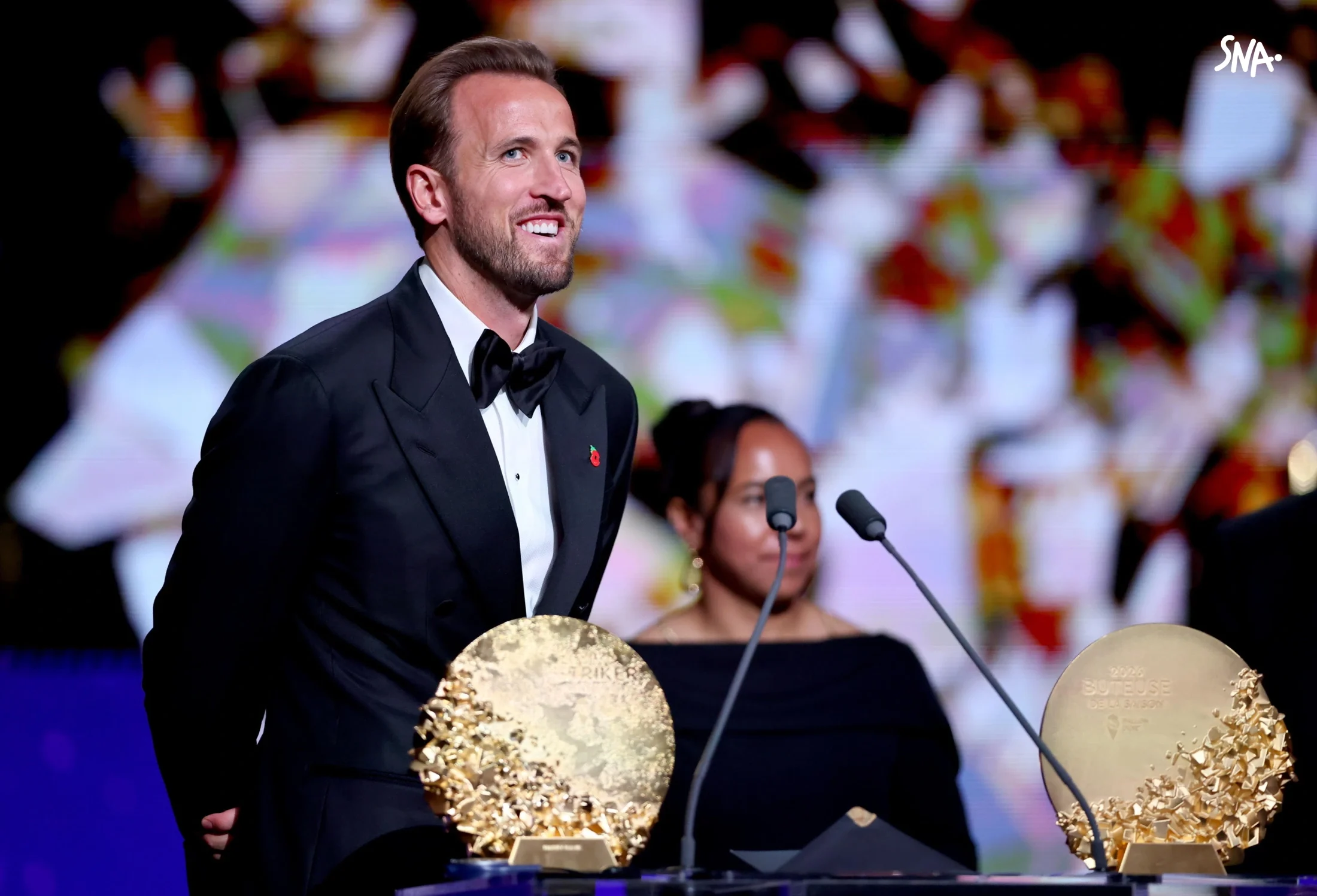
Harry Kane’s first Ballon d’Or crowns a historic 2025/26 season: 73 goals in 65 appearances for Bayern Munich and England. The 33-year-old was named the winner in London on Monday 26 October, ahead of Kylian Mbappé and Lamine Yamal. Exceptional scoring, three domestic trophies and a third-place World Cup finish combine to explain the scale of his achievement.
A season built for the highest recognition
Kane has secured the individual honour that defines this chapter of his career. The strength of his 2025/26 campaign lies in the accumulation of contributions: league goals, sustained European scoring and cup performances that directly helped Bayern win silverware. His case did not depend on a single tournament or one outstanding evening.
That consistency gives substance to his success ahead of Mbappé and Yamal. Kane maintained a high scoring rate across competitions before extending his season with England. In a field containing several credible candidates, those returns offer a concrete explanation for the voters’ verdict. Goals alone do not capture every criterion of an individual award, but they form the clearest foundation of this particular campaign.
Sixty-one Bayern goals and a personal best
Kane scored 61 goals in 51 competitive appearances for Bayern, adding seven assists. That works out at almost 1.20 goals per appearance. It was his best club scoring season and one of the most prolific campaigns in Bayern’s history.
The breakdown matters as much as the headline number: 36 Bundesliga goals, 14 in the Champions League, ten in the German Cup and one in the Supercup. His league return earned a third successive German top-scorer award and the European Golden Shoe. The latter measures scoring in domestic league competitions, weighted by league; it does not include cup or international goals.
The Bundesliga supplied the largest share, but the other competitions added another 25 goals. His influence therefore continued when the schedule changed and Bayern faced opposition beyond their league rivals. Maintaining that output across several fronts gives the full season its coherence.
A cup final decided by his hat-trick
The German Cup final provides a particularly clear example of Kane’s impact. Bayern beat Stuttgart 3-0, with the England striker scoring all three goals. He finished the competition with ten goals in six appearances and supplied every goal in the match that directly decided the trophy.
Bayern also won the Bundesliga and the Supercup. Kane’s scoring awards were therefore accompanied by team success. The Ballon d’Or adds another distinction to that season’s achievements, while the Gerd Müller Trophy he received at the same ceremony recognises his scoring production more specifically.
Fourteen European goals on a semi-final run
Kane scored 14 times in 13 Champions League appearances, placing second in that season’s scoring chart behind Mbappé’s 15. Bayern’s run ended in the semi-finals, but their centre-forward still maintained a return of more than a goal per appearance in the competition.
His European scoring extended the form he showed in Germany. Although Bayern fell in the last four, he finished among the continent’s most consistent scorers, strengthening his case for the Ballon d’Or.
Twelve more goals with England
Kane added 12 goals in 14 England appearances: five in World Cup qualifying, six at the finals and one in a friendly. That brought his combined club-and-country return to 73 goals in 65 games. His six World Cup goals contributed to England’s third-place finish.
International football added a different setting to his year. The captain continued scoring with different team-mates and demands around him. His contribution also extended beyond finishing: the season’s record includes seven Bayern assists and one for England. Alongside his own goals, there was a contribution to the success of others.
Twenty-five years after Michael Owen
Kane’s award ends a 25-year wait for an English winner. He becomes the fifth Englishman to lift the Ballon d’Or after Stanley Matthews in 1956, Bobby Charlton in 1966, Kevin Keegan in 1978 and 1979, and Michael Owen in 2001.
At 33, Kane joins that history after a season in which scoring returns and trophies came together. The overall number is striking; the occasions on which he scored explain its wider significance. From the Bundesliga campaign to the cup final and England’s summer, he built his case over an extended period.
Our Ballon d’Or round-up covers the ceremony’s other awards and full ranking. You can also explore Kane’s current statistics, Bayern’s upcoming fixtures and the Bundesliga standings below. Those live season figures are separate from the completed 2025/26 campaign examined here.
The complete SNA Ballon d’Or round-up · Bayern Munich · Current Bundesliga standings