
Champions League: Kane, Doué, Foden… the SNA XI and our five flops
Kane the creator, Foden decisive again: SNA explains its XI for 20 and 21 October, its three substitutes and its five flops.
Rieltony LOUBOKO · Author profile ·
Listen to this story
Synthetic English voice · 18 min 58 s

Harry Kane gave Bayern a playmaker as well as a centre-forward. Phil Foden, starved of goals for so long, has just scored four in two games. And Lucas Hernández showed that a great full-back performance starts with the duel you have to win. After the Champions League nights of 20 and 21 October, here are Sport News Africa's picks: a XI in a 4-3-3, three substitutes who were hard to leave out and five flops whose performances deserve debate.
We have picked out the moments that tip a game, but also what makes them possible: a pass that breaks the press, a run that frees a team-mate, a recovery that prevents a goal. Recent form sheds light on these performances; it does not replace judgement of the two nights themselves. This XI is ours, with its preferences and its sacrifices.
The SNA XI, in a 4-3-3
Josep Martínez — Sergiño Dest, Lutsharel Geertruida, Jacobo Ramón, Lucas Hernández — Vitinha, Declan Rice, Scott McTominay — Phil Foden, Harry Kane, Désiré Doué.
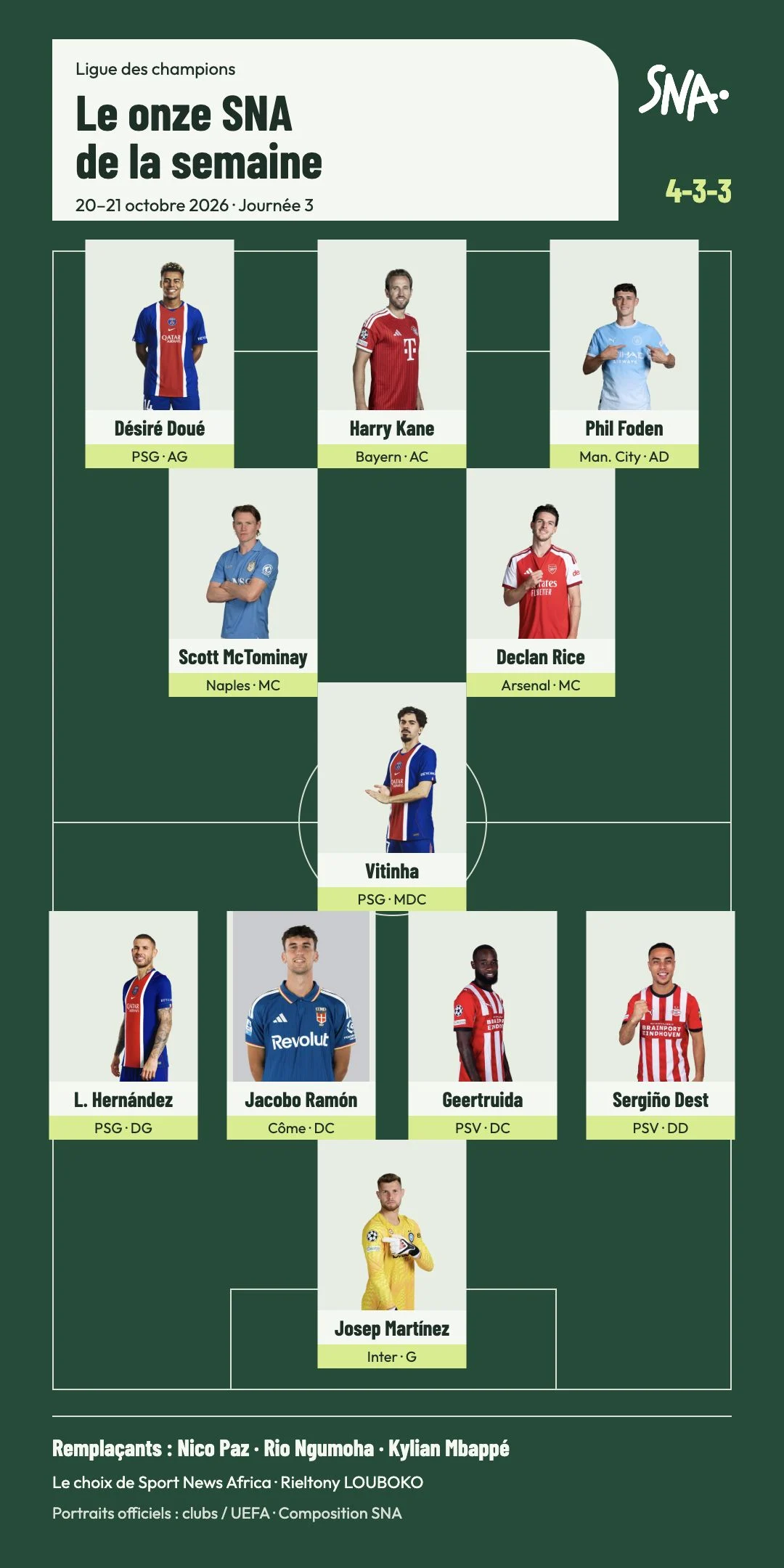
Attack: Kane thinks the game, Foden finds the light again
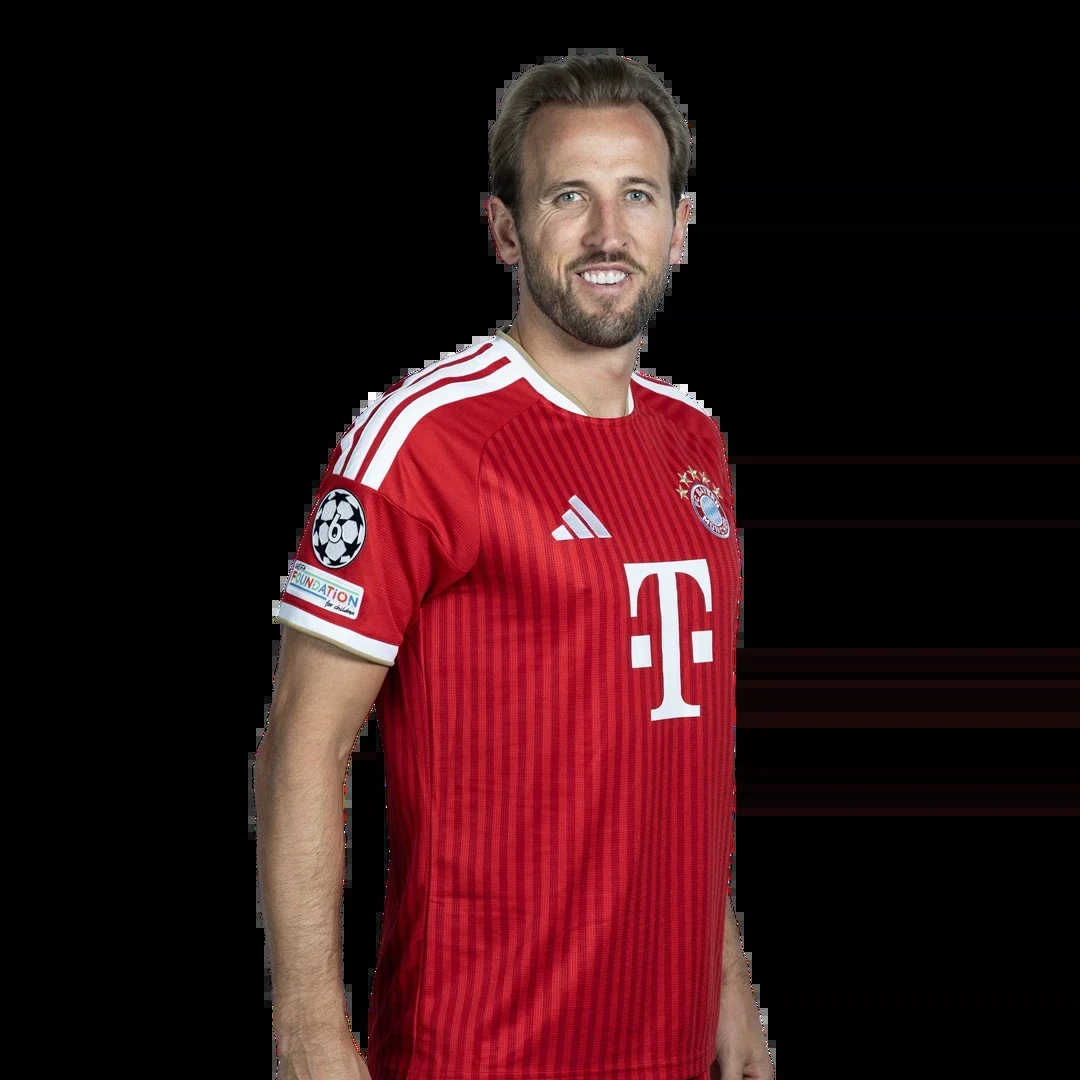
Harry Kane, centre-forward: a number nine who makes his team bigger
The 2-2 between Bayern and Arsenal is best understood by following Kane rather than just the scorers. The Londoners had taken control of midfield and led 1-0. The Bayern man then dropped much deeper to get on the ball. From around the centre circle, he picked out Alphonso Davies's run with a pass that cut through the opposition's shape. Davies equalises. Kane had just solved, with a midfielder's vision and execution, a problem Bayern had been struggling to fix.
He had already helped create a chance for Gnabry, taking a goal kick himself, from six metres, towards Davies. Seeing him so far from the box shows the extent of his involvement: he helps Bayern play out of pressure, spots the run in behind, then gets forward again to finish moves. In the second half, his shot hits Timber's hand; he converts the penalty. The creator and the finisher wear the same number on their back.
That is why his place up front is a given for us. To reduce his night to a goal and an assist would erase the link he created between Bayern's different lines. Against opposition of this calibre, his influence stretched well beyond the penalty area. It is that complete performance we are rewarding.
Phil Foden, right winger: the hat-trick has a back story
Three goals against AEK Athens, an assist for Cherki and a 5-1 win: the match sheet is already convincing. But Foden was coming off ten months without scoring for City before his goal against Ipswich on Saturday. In a matter of days, a long wait has given way to four goals. His European hat-trick gives a whole different weight to the first signal sent in the league.
His link-up with Rico Lewis is at the heart of his night. Foden finishes two moves set up by his team-mate, makes himself available in the right zones and strikes the ball accurately. In between, he sets up Cherki for 3-1, just as AEK had pulled one back. He then completes his hat-trick from a McAidoo cross. He helps build the result as much as he benefits from it.
The opposition was weaker than that faced by Kane or the Parisians. That counts in our assessment. What we like about Foden is the sharpness of his response after this difficult spell, his understanding with the players around him and the variety of his contributions. We place him on the right, with the freedom to drift inside, in a role he knows. Two games are not enough to announce a definitive rebirth; they are more than enough to hand him back his place in our XI.
Désiré Doué, left winger: accelerate, then make the right move
Against Barça, Doué gave Paris's work a concrete outcome. Set up by João Neves, he opens the scoring with a shot struck so quickly that the defence had little time to react. He then supplies the ball that Lucas Hernández heads in for 2-1. Paris win 4-2, with a forward able to finish one move and create another for a team-mate.
His display fits into a solid run: he had scored in each of his previous two outings. That continuity helps explain his current confidence. He did, however, have a less tidy start and a harder end to the game, notably after moving to the left. Our choice keeps that nuance. We put him on that side in the SNA XI because of his versatility, without claiming to sum up his match against Barcelona.
His place rewards above all his ability to turn an acceleration into a usable advantage. The opponent backs off, then the ball arrives in the right place. That is what we expect from him alongside Kane and Foden.
Midfield: control and runs that count
Vitinha, holding midfielder: able to run the game and to shake it up
At 2-2 against Barcelona, the match could still have slipped away from Paris. Vitinha restored the lead with a long-range strike, almost immediately after Lamine Yamal's equaliser. The timing gives the moment its value: Barça had just caught their breath, and the Portuguese immediately forced them back into chasing the scoreline.
His place in front of our defence also rests on the quality of his distribution. The diagonals, the cover and the passes that allow a team to play out and then attack went hand in hand with the goal. With him, team-mates can push forward knowing one player remains available to link the movements. We want that continuity in a side where Rice and McTominay are meant to get forward.
Shooting from distance is, after all, one of his regular weapons. His efficiency from there forces opponents to close him down, which opens up other passing options. The conductor can also make everyone change tempo.
Declan Rice, right central midfielder: involved right to the end
In Munich, Rice was central to Arsenal's good start, then kept providing options when Bayern retook the lead. His corners notably put the German defence under pressure, including that Bruno Guimarães header that Neuer kept out on his line. His attacking influence was already there before the 82nd minute.
The equaliser then gives a very clear picture of what we want in his position. Rice advances, takes part in a sequence with Madueke and Gyökeres, then keeps running to receive the return pass and finish. He doesn't leave the attackers to fend for themselves ahead of him. His movement brings an extra man into the zone where Arsenal need to make the difference.
The context reinforces our choice: delivering that contribution at the Allianz Arena, in a game played at that tempo, demands quality and composure. Rice takes our right-hand central midfield spot for this mix of energy, presence and power going forward. His goal adds to his performance.
Scott McTominay, left central midfielder: arriving where Napoli need him
Napoli won 4-3 against Bodø/Glimt without ever managing to make themselves safe. In that disorder, McTominay put the Italians back in front twice: at 2-1, then at 3-2. He also hit the post. His repeated presence near goal explains his selection far better than a simple "brace" line.
On the first goal, he benefits from a move built with De Bruyne and from Lang's movement. On the second, he rises to meet Politano's cross. He knows how to spot the moment when a move needs a midfielder arriving in the box. He then offers a target, impact and finishing to a side whose centre-forward can't absorb everything.
We value this ability to go again, even when Napoli have just lost their lead. The three goals conceded rule out calling it a perfectly controlled collective display. But without his arrivals, the night would have had a very different complexion. In our midfield, Vitinha provides the reference points; McTominay attacks the spaces that open up in front of him.
Defence: duels, cover and the courage to get back
Sergiño Dest, right-back: pace in the service of the three points
PSV win 1-0 at Porto, but the match forces them to defend situations far more dangerous than the score suggests. When Kovář comes out, Alberto Costa beats the goalkeeper for pace and chases the ball towards goal. Dest recovers from the side and intervenes before the touch that could have been enough to equalise.
This run sums up an essential aspect of the position. A full-back who pushes forward must also know how to turn, gauge the urgency and see the recovery through. Dest does so when the organisation around him has already been beaten. His pace becomes a tool to protect the result.
He also took part in the combinations on the right with Bajraktarević. We reward this dual contribution in an away game where PSV had to react after their weekend defeat against ADO. It might have been tempting to pick a full-back for his crosses alone. Dest's most valuable contribution that night came near his own goal.
Lutsharel Geertruida, centre-back: there before and after the danger
Porto also ran into Geertruida. After a failed distribution from Kovář and a first save by the goalkeeper, the defender cleared Froholdt's attempt off the line. With one goal in it, that reading of the game and positioning had an immediate effect on the result.
His game also includes a contribution to the build-up: he notably finds Perišić for a headed chance early on. That is interesting for our centre-back pairing. Geertruida can help move the team forward, then stay alert enough to make amends when the first line of protection gives way.
PSV suffered, so we are not presenting his performance as a night spent controlling everything. We note the response of a centre-back in a match that really required him to intervene. The spectacular goal-line clearance catches the eye. The point of his selection is to pair that intervention with a useful presence at both ends of the pitch.
Jacobo Ramón, centre-back: taking his share of the control
In Como's 4-1 against Manchester United, Nico Paz naturally catches the eye. Ramón deserves a look at what happens behind him too. With Kempf, he contained the Manchester attackers and allowed his side to keep playing forward. His selection starts with that defensive authority.
His goal then shows an additional quality. Ramón takes part in the build-up, moves forward and ends up on the end of Kaiki's cross to head in. That fourth goal comes from movement in open play. It illustrates the confidence of a centre-back able to support an attack after helping start it.
One reservation remains: on Zirkzee's late consolation, he leaves too much space. The lead was secure, but the demands remain. We choose him for his overall performance, keeping that lapse in concentration in the judgement. He did more than decorate the win with a goal.
Lucas Hernández, left-back: a duel that gives the choice meaning
Replacing Nuno Mendes and finding himself up against Lamine Yamal was quite a test. Hernández approached it with aggression in the duels, tight marking and a determination to disrupt the winger's ball control. For a long time he stopped the Barcelona man playing with the comfort he seeks. That is the first argument for his selection.
The second comes in the 72nd minute: his header from Doué's ball puts Paris back in front. For a player who had not started a Champions League match since January 2025, the contribution is considerable. He answered a precise defensive need and contributed to the scoreline at a time when the game demanded fresh effort.
Taken off in the 78th, he is no longer on the pitch when Yamal equalises. It would be excessive to make that sequence alone proof that everything depended on him. It nonetheless reminds us why his work against this opponent deserves close attention. His goal crowned a genuine full-back's performance.
Josep Martínez, goalkeeper: the saves that change the weight of an evening
Inter needed their first win of this European campaign. The 1-0 against Shakhtar nonetheless became complicated with Bastoni's sending-off, at 0-0. In that context, Martínez delivered what his team expected: a decisive presence when the margin became very small.
His save from Bondar's header, before the break, first stops Inter from having to chase the game. In the closing stages, he again stands firm against Newertton and then on a Matviyenko header. Carlos Augusto may be the hero of the goal; the goalkeeper is the one who gives that goal the value of three points.
After more difficult early European outings, his response also counts in his personal trajectory. Here we favour responsibility shouldered in a tense match. He had to make several important interventions, at different moments, for the night to remain one of victory.
The bench: three places, real regrets
Nico Paz: the choice that leaves us most open to challenge
Two goals, an assist, opponents forced to stop him by fouling: Paz set the rhythm in Como's 4-1. He opens the game with a left-footed shot, finds Douvikas in behind, then wins the ball from Baleba to score the third. He creates, accelerates and takes part in winning the ball back. Reducing him to a pretty playmaker would miss his night.
His place on the bench is the harshest sacrifice in our selection. We keep Vitinha to organise and the Rice–McTominay pairing for the runs from midfield. That choice of complementarity is debatable: judged solely on the brilliance of his individual display, Paz would have a very strong case to start. He is our first option to transform the midfield during a match.
Rio Ngumoha: seven successful dribbles, and a displaced defence
At 18, Ngumoha completed seven of his eight dribbles against Villarreal and provided two assists in Liverpool's turnaround, from 0-2 to 4-3. His value shows in what he imposes on the opponent: the full-back has to drop back, a second defender comes to help, spaces open up for team-mates. Mac Allister notably benefited on the third goal.
He also set up Araújo for the equaliser before the break, with a cross from the left following a corner. He still needs to read some of the off-the-ball cover requirements better, in a first half in which Liverpool suffered on the flanks. The reservation is real, without diminishing his attacking display. We keep Kane in the middle and Foden on the right; Ngumoha remains the player on our bench able to change the nature of the duels immediately.
Kylian Mbappé: a persistent threat, then the right touch
Against Leipzig, Mbappé tried, accelerated and sometimes chose badly, before weighing on the result. His header sets up Arda Güler's goal, then he scores with a powerful strike from the edge of the box from a Diomandé ball. Real win 4-1 and the Frenchman finishes with a goal and an assist.
We note this ability to stay dangerous even when chances don't go in straight away. But the competition forces a choice. Kane had more influence on the build-up against Arsenal; Foden scored a hat-trick and Doué made his mark against Barcelona. From the bench, Mbappé gives us another way of attacking the space in behind. His absence from the XI says something about our preference over these two nights, not about any poor performance from him.
Our five flops: performances to judge, reasons to give
1. Berke Özer: Lille needed a save, not another turning point
LOSC had responded twice and gone in at the break at 2-2 against Galatasaray. In the 52nd minute, from a corner, Torreira gets across at the near post to head in and catches Özer by surprise. It was a poor piece of judgement at a moment when Lille precisely needed to find stability. The match tips towards a 2-4 defeat.
Lille's defensive problems do not all rest on their goalkeeper. Alexsandro and the rest of the block also suffered. But Özer had to provide extra security to a team already beaten in their first two European matchdays. On this key action, he adds a weakness. Our criticism concerns that inadequate response and its weight in the story of the game. The charge is heavy enough without attributing to him all of his team-mates' errors.
2. Alessandro Bastoni: two minutes that force others to compensate
A first yellow in the 66th, a second in the 68th after pushing an opponent away: Bastoni leaves Inter–Shakhtar with nobody having scored. Until that sequence, his performance was still defensible. In two minutes, he forces a side seeking their first European win to finish with ten.
It is that shift of responsibility that bothers us. An experienced centre-back must factor the first booking into the rest of his match. The contact that followed also commits his team-mates' efforts. Martínez must keep protecting the goal, Carlos Augusto finds the way to victory, and Inter get through 1-0. Bastoni owes them a great deal. The collective reaction saves the result; it leaves the question of his control unanswered.
3. Vinícius Júnior: two flashes are not enough to fill his role
To say he did nothing against Leipzig would be false. Vinícius forced Vandevoordt into action and produced a few accelerations in the first half. That is also why his place among the flops is debatable. We maintain it for the lack of continuity in his influence, particularly after the break, before his substitution in the 70th minute.
The contrast with Diomandé, who came on in his place and then scored and provided an assist, is brutal. The substitute used his time to offer solutions and finish. Vinícius, by contrast, did too little in a game that nonetheless offered space. His lack of a goal or an assist is not in itself a condemnation; the difficulty in extending his good spells reinforces the verdict. In a Real side winning 4-1, his performance remains far from what his role demands. His talent makes this quietness even more frustrating.
4. Carlos Baleba: coming on to steady midfield, losing the ball that sinks him
Baleba comes on at half-time at Como, with United trailing 1-0. The midfield needs to resist better, keep the ball and slow the opposition's moves. Soon after, Nico Paz takes the ball off him and goes on to score the third goal. The player called on to help close the gaps has just opened a particularly costly one.
The situation he inherits is already bad. It is not up to him to repair, alone, an entire side being dominated. But his introduction has to be judged on what it adds: here, too little resistance and a turnover that was punished directly. The final 4-1 tells of a collective shipwreck; this action explains why we also single out his performance. The midfield needed to be harder to get through. Paz again found the way through.
5. Sergi Cardona: scoring at Anfield, then suffering down his flank
His run to score Villarreal's 2-0 is well executed. It exploits the space left on Liverpool's right and rewards good collective play. Then Ngumoha changed the terms of the duel. Cardona suffered against his pace and his ability to start the dribbles again, even with help around him.
After a corner, the young winger supplied the cross for Araújo's equaliser, then went wide on the right to set up Mac Allister for the goal that puts Liverpool ahead. The Spanish defence share the responsibility: the cover and the protection of the box did not work well enough. But a full-back cannot judge his night on a single visit to the opposition box. Cardona helped build a magnificent lead, then did too little to protect his flank while that lead disappeared. It is that mismatch that sends him into our flops.